Plant Selection

Plants that Attract Butterflies

Choose plants that attract and sustain butterflies through their entire life cycle.

Content Detail

Success Factors

There are a few simple things that will help a butterfly garden be successful. Get to know what butterflies are in your area. That will help when it is time to select plants.

Locate your garden in a sunny area. Butterflies more commonly visit flowers growing in sunny sites, although some will come to flowers in partial shade.

Plant the garden with flowers butterflies prefer. Many butterflies prefer flowers that provide a landing platform. These would include large flowers and large clusters of smaller flowers. Butterflies have long mouthparts that can get into tubular flowers, so be sure to include some species with short-tubular flowers.

Use large swaths of color. Butterflies are attracted to flowers by their color, so planting in masses of flowers makes it easier for them to find that single planting.

Provide continuous flowering throughout the growing season. Butterflies are active from spring into late fall, but mid-to-late season is a time of high activity for many butterflies.

Provide food for your butterfly caterpillars. To increase the number of butterflies in your garden, include plants that are larval hosts (plants on which caterpillars feed).

Include shallow watering areas. Many butterflies drink from moist soil or shallow puddles, sometimes forming large groups called puddle clubs. They not only get water from these puddles, but can also get minerals that are dissolved in the water.

Provide sheltered, shady areas. Butterflies often need cool-down areas in hot weather and need protection from wind, rain, and predators. Trees and shrubs can provide this type of shelter.

Use pesticides cautiously. Butterflies are easily killed by insecticides. Try using non-chemical methods of pest control.

Some butterflies do not feed on the nectar of flowers, but prefer ripe fruit and sap flows. Add some overripe melon rinds and fruit to the butterfly garden.

Butterfly Life Cycle

Butterflies go through distinct stages in their life cycles: egg, larvae, pupa, and adult.

Butterfly eggs are laid on or near a larval host plant. When the larva (caterpillar) hatches out, it will feed on the larval host plant, growing and molting until it is ready to pupate. The caterpillar will form a pupal case (chrysalis or cocoon) in preparation for the transformation into a butterfly. After a period of time in the pupal case, the transformation of the caterpillar will be completed and the adult butterfly will emerge from the pupal case.

Most butterflies only have one generation per year and, as adults, may live for only two to three weeks. During this brief period, they need to find a mate, reproduce, seek out food and shelter, as well as find nourishing nectar to fuel all these activities. Requirements will vary from species to species.

Butterfly larvae (the caterpillar stage), on the other hand, depend solely on certain plant species for food, known as larval host plants. Larval host plants range from annuals and perennials to trees and shrubs. While most larvae have voracious appetites, they only feed on a few plant species and any leaf damage is usually short-lived and non-threatening to the plant so it’s well worth the effort. To allow butterflies to complete their life cycle, the gardener must accept a small amount of damage to some of their plants.

Perennial Plants that Attract Butterflies

This is not a complete list. (*Indicates plant native to the Midwest. **Indicates plant with some species native to the Midwest and some not.)

Achillea** spp. (yarrow)
Butterflies attracted: American copper, coppers, hairstreaks, skippers

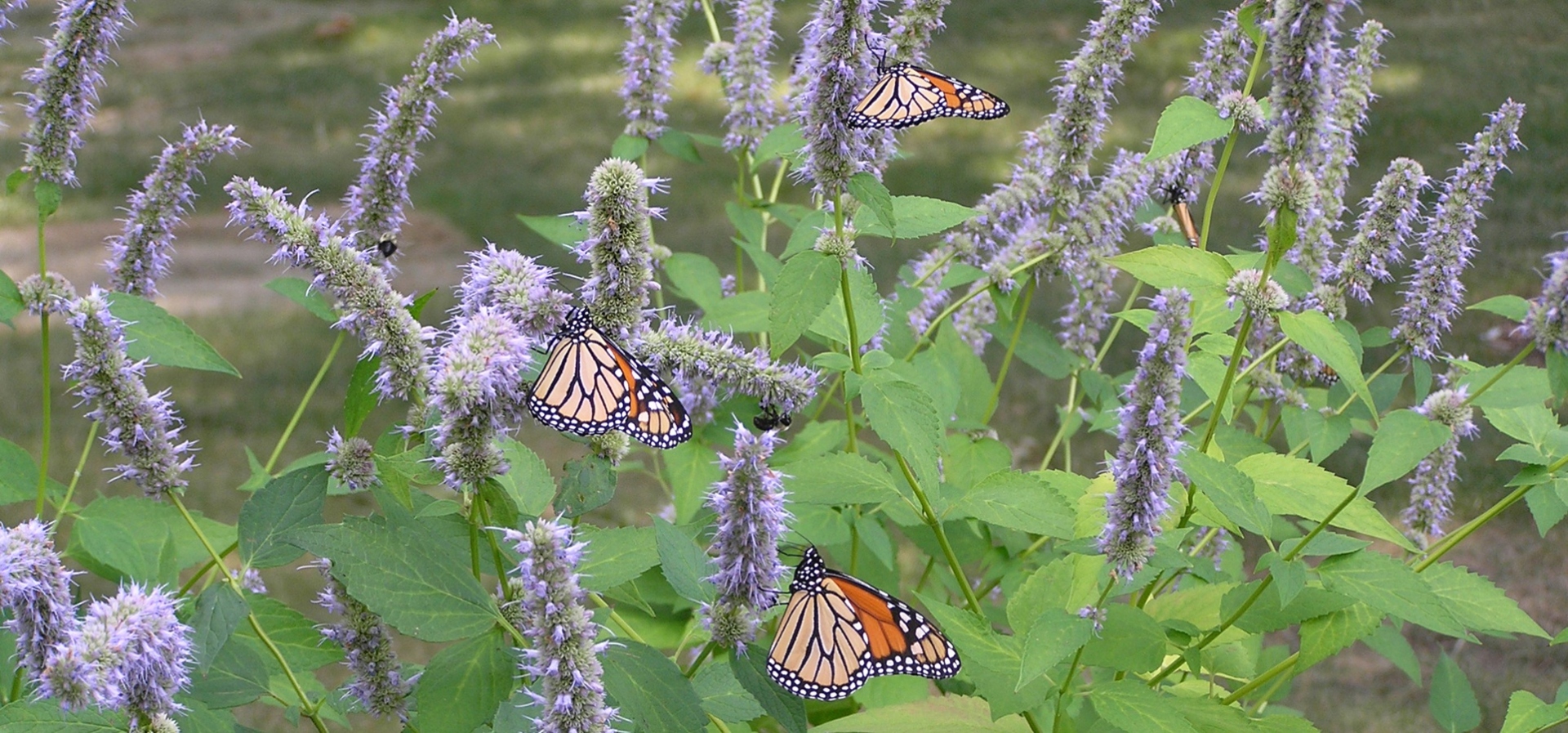
Agastache foeniculum* (anise-hyssop)
Butterflies attracted: red admiral, monarch, painted lady, buckeye, Milbert’s tortoiseshell, pipevine swallowtail, sulphur

Amorpha canescens* (lead plant)
Larval host for: dog face sulphur
Butterflies attracted: painted lady, red admiral, fritillaries, sulphur, blues

Anaphalis margaritacea* (pearly everlasting)
Larval host for: American lady

Asclepias incarnata* (swamp milkweed)
Larval host for: monarch
Butterflies attracted: monarch, Edward’s hairstreak, banded hairstreak, Acadian hairstreak, gray hairstreak, Eastern tailed-blue, great spangled fritillary

Asclepias syriaca* (common milkweed)
Larval host for: monarch.
Butterflies attracted: monarch, coral hairstreak, striped hairstreak, Edward’s hairstreak, banded hairstreak, Acadian hairstreak, Eastern tailed-blue, black swallowtail, tiger swallowtail, spicebush swallowtail, checkered white, American copper, great spangled fritillary, pearl crescent, silver-spotted skipper

Asclepias tuberosa* (butterfly weed)
Larval host for: monarch
Butterflies attracted: monarch, coral hairstreak, striped hairstreak, Edward’s hairstreak, banded hairstreak, Acadian hairstreak, Eastern tailed-blue, black swallowtail, tiger swallowtail, spicebush swallowtail, checkered white, American copper, great spangled fritillary, pearl crescent, silver-spotted skipper

Aster x frikartii (Frikart’s aster)
Larval host for: dog face sulphur, orange sulphur, clouded sulphur, Eastern tailed-blue.
Butterflies attracted: buckeye, viceroy, checkered white, painted lady, monarch, Eastern tailed-blue pearl crescent, American painted lady, cloudless sulphur, clouded sulphur, common checkered-skipper, hairstreak.

Baptisia alba* (wild white indigo), Baptisia australis* (blue false indigo)
Larval host for: dog face sulphur, orange sulphur, clouded sulphur, Eastern tailed-blue
Butterflies attracted: orange sulphur, clouded sulphur, Eastern tailed-blue

Carex** spp. (sedge)
Larval host for: Little Wood-Satyr

Centaurea** spp. (cornflower)
Butterflies attracted: common checkered-skipper, buckeye

Ceratostigma plumbaginoides (leadwort)
Butterflies attracted: painted lady, red admiral, viceroy, blues, sulphur

Chelone lyonii (pink turtle-head),Chelone glabra* (white turtlehead)
Butterflies attracted: silver-spotted skipper, spicebush swallowtail, tiger swallowtail

Coreopsis grandiflora* (tickseed), Coreopsis lanceolata* (lance-leaved coreopsis), Coreopsis rosea (pink coreopsis),Coreopsis verticillata (whorled coreopsis)
Larval host for: silvery checkerspot buckeye
Butterflies attracted: buckeye, viceroy, Eastern tailed-blue, spring azure, pearl crescent, orange sulfur, American copper, red admiral

Echinacea pallida* (pale purple coneflower)
Butterflies attracted: American lady, great spangled fritillary, red admiral

Eupatorium* spp., including Eutrocium* (Joe Pye weed)
Butterflies attracted: azure, Eastern tiger swallowtail, monarch, silver-spotted skipper, white admiral.

Lavandula angustifolia (English lavender)
Butterflies attracted: Eastern tailed-blue, monarch, whites, swallowtail

Liatris* spp. (Blazing-stars)
Butterflies attracted: common wood nymph, great spangled fritillary, monarch, painted lady, Peck’s skippers

Linaria purpurea (purple toadflax)
Larval host for: buckeye

Lupinus perennis* (wild lupine)
Larval host for: Karner blue
This is the only larval food source for Karner blue.

Monarda fistulosa* (wild bergamot)
Butterflies attracted: Eastern tiger swallowtail, great spangled fritillary, monarch, silver-spotted skipper

Rudbeckia hirta* (black-eyed susan), Rudbeckia laciniata* (cut-leaf coneflower)
Larval host for: Silvery Checkerspot
Butterflies attracted: great spangled fritillary, silver-bordered fritillary, pearl crescent, viceroy, monarch, blues

Ruellia humilis* (wild petunia)
Larval host for: buckeye

Scabiosa columbaria ‘Butterfly Blue’ (butterfly blue pincushion flower)
Butterflies attracted: painted lady, red admiral, sulphur, swallowtails

Solidago** and Oligoneuron** spp. (goldenrod)
Larval host for: Baltimore, silvery checkerspot
Butterflies attracted: monarch, silver-spotted skipper, clouded sulphur, viceroy, gray hairstreak

Symphyotrichum laeve* (smooth blue aster), Symphyotrichum novae-angliae* (New England aster), Symphyotrichum novi-belgii* (New York aster)
Larval host for: pearl crescent, silvery checkerspot
Butterflies attracted: buckeye, viceroy, checkered white, painted lady, monarch, Eastern tailed-blue pearl crescent, American painted lady, cloudless sulphur, clouded sulphur, common checkered-skipper, hairstreak

Symphyotrichum ‘Wood’s Light Blue’ (Wood’s light blue aster)
Larval host for: Baltimore
Butterflies attracted: buckeye, viceroy, checkered white, painted lady, monarch, Eastern tailed-blue pearl crescent, American painted lady, cloudless sulphur, clouded sulphur, common checkered-skipper, hairstreak

Verbena** spp. (verbena)
Butterflies attracted: great spangled fritillary, swallowtail, sulphur

Viola sororia* (violet)
Larval host for: great spangled fritillary, variegated fritillary, Aphrodite fritillary

Zizia aurea* (golden Alexanders)
Larval host for black swallowtail
Annuals that Attract Butterflies

This is not a complete list. (*Indicates plant native to the Midwest. **Indicates plant with some species native to the Midwest and some not.)

Alcea spp. (hollyhock)
Larval host for: American painted lady, painted lady, comma, common checkered-skipper.

Antirrhinum spp. (snapdragon)
Larval host for: buckeye

Centaurea cyanus (cornflower)
Larval host for: American painted lady

Cleome spp. (spider flower)
Larval host for: checkered white

Echium vulgare (viper’s bugloss)
Larval host for: buckeye

Helianthus spp. (sunflower)
Larval host for: silvery checkerspot

Impatiens balsamina (garden balsam)
Larval host for: American painted lady

Lantana camera (lantana)
Butterflies attracted: giant swallowtail, pipevine swallowtail, spicebush swallowtail, red-spotted purple, cloudless sulphur, and Gulf fritillary

Tropaeolum majus (common nasturtium)
Larval host for: cabbage white

Herbs that Attract Butterflies

This is not a complete list. (*Indicates plant native to the Midwest. **Indicates plant with some species native to the Midwest and some not.)

Anethum graveolens (dill)
Larval host for: black swallowtail

Artemisia dracunculus* (tarragon)
Larval host for: swallowtails

Humulus lupulus* (common hops)
Larval host for: gray hairstreak, question mark, red admiral

Levisticum officinale (lovage)
Larval host for: black swallowtail

Origanum vulgare (oregano)
Butterflies attracted: pearl crescent, hairstreak

Petroselinum crispum (parsley)
Larval host for: black swallowtail

Pimpinella anisum (common anise)
Larval host for: black swallowtail

Ruta graveolens (common rue)
Larval host for: black swallowtail, giant swallowtail

Salvia officinalis (garden sage)
Butterflies attracted: swallowtail, sulphur

Weeds that Attract Butterflies

The Morton Arboretum does not advocate planting weeds, but if these weeds are present naturally they will be used by some butterflies.

Boehmeria spp. (false nettle)
Larval host for: red admiral

Daucus carota (Queen Anne’s lace)
Larval host for: swallowtails
Butterflies attracted: swallowtails

Rumex acetosella (sheep sorrel)
Larval host for: American copper

Trifolium spp. (clover)
Larval host for: clouded sulphur, Eastern tailed-blue, gray hairstreak