Plant Care Resources

How to Water Plants

Discover how to properly water plants using a variety of tools.

Content Detail

Watering is a simple yet essential part of caring for plants. Keep your trees, shrubs, and other garden plants adequately watered by following the guidelines listed here. They detail everything from how and when to water to proper use of a wide variety of watering tools. If you need further information on proper watering, consider contacting the Plant Clinic for more detailed advice.

Contact the Plant Clinic for Advice

The Morton Arboretum’s Plant Clinic is a free service that can advise on proper plant care and answer your questions. You can contact the Plant Clinic by submitting your question online anytime.

Explore other Plant Care Resources online.

Why Is Water Important?

Water is essential to all life forms, and plants need water to survive. But we don’t just want our plants to survive, we want them to thrive. They need it to live and to grow (make new plant parts) and to reproduce (flower and produce seeds). When we turn on the garden hose or lawn sprinkler, we should make sure that every drop is used well by watering properly.

Water and Photosynthesis

On a hot, dry day, watering a plant prevents it from wilting. But water is important to plants in so many other ways. Water plays an essential role in photosynthesis, the process by which plants make their own food. This is not the food we give plants when we fertilize (nitrogen, phosphorus, and potassium). Through photosynthesis, plants make sugar (carbohydrates) that they burn for energy so they can complete various biological processes. Water helps plants produce chlorophyll, the green pigment that is necessary for photosynthesis. Plants need to make new chlorophyll every day. If water is in short supply, chlorophyll is not formed and leaves turn yellow.

Water is also involved in the photosynthetic process itself. In that process, carbon dioxide molecules and watermolecules are converted into sugar (carbohydrates) and oxygen molecules in the presence of light energy captured by chlorophyll. So without water, plants can’t make carbohydrates, and the food supply is inadequate. Using fertilizer does not make up for this food shortage.

Water Helps Plants Grow

Water also plays an important role in plant growth, partly because of its role in photosynthesis, but also because it is needed to help with the development and expansion of new plant parts.

Trees form their leaf buds for next year in the current summer. If there is a lack of water during summer, bud formation will be affected, so fewer buds may form, and those that do form may be smaller than normal. Watering your tree in the summer not only keeps it from wilting, it also helps with the production of the buds that will produce leaves and stems next year. Watering is an investment in the future growth of that tree.

Water Helps Roots Grow

Water is the essential ingredient for root growth. In a dry season, roots are at risk for damage. Roots that have been cut during construction have been damaged. A tree that is dug from a nursery field and planted in a new location has suffered root damage. In all these cases, the tree will need to produce new roots. Water is needed so the remaining roots can keep supplying water to the tree, but it is also needed for the tree to develop new roots and expand its root system. The carbohydrates made through photosynthesis help with new root growth.

Water Helps Plants Produce Flowers, Fruits, and Seeds

Water is also important in flowering and reproduction. Water is essential for the development of leaf buds, and it is equally important for the development of flower buds. Water also plays important roles in the development of fruits and seeds. When a fruit or seed pod starts to grow, plants send lots of carbohydrates to that fruit. Fruit production is a high priority on the list of plant parts that need carbohydrates. If water is lacking and carbohydrate production (photosynthesis) is decreased, fruits and seeds may fail to develop or may develop poorly. Also, fruits that are juicy need water to make them so.

When we water our plants, we are doing so much more than just getting them through a dry spell. We are helping them carry out their day-to-day biological functions, and helping them to grow and develop for the future.

Proper watering provides the best chance for a plant to live a long, healthy life.
How and When to Water Trees and Other Plants

Check the Soil

Watering trees, shrubs, and other plants on a schedule is not efficient or reliable. Watering should be done based on soil conditions and weather conditions. Weather conditions can vary widely from week to week, and that affects how much water is needed. There is no way to look at the soil from above and tell how much moisture is in it. Dry soils can cause the death of small roots and reduce a tree’s capacity to absorb water, even after the soil is re-moistened. Drought stress can increase a tree’s susceptibility to certain diseases and insects. To check the soil’s moisture, insert a hand trowel into the soil and tip out an inch or two of soil. If those one or two inches are moist, there is no need to water. If they are dry, then it is time to water.

Avoid Frequent, Light Watering

Watering lightly on a frequent basis does not allow water to go deeply into the root system. Instead, water deeply so that water penetrates into the soil at least five to six inches. An inch of water applied at one time can penetrate into the soil that far. The tip of your trowel can confirm that you are watering to that depth. If you need to water your plants every day, then you are not watering deeply enough when you do water and your plant is not receiving enough water at any time. Focus on the concept of watering thoroughly and less frequently, based on soil and weather conditions.

Water the Roots

There is no reason to water the leaves of a plant. Water the soil, where the roots are. The Morton Arboretum recommends watering around the drip line of a tree (under the ends of the branches). This is the location of the roots most able to take up water effectively. The water-absorbing roots of even large trees are within the top two feet of soil. The objective is to keep roots moist, but not wet.

Keep Checking in Autumn

Trees and shrubs, especially newly planted ones and evergreens, need ample water in their root systems as they prepare for winter. Continue to water as long as the soil is not frozen and can accept water. There is no specific cutoff date to stop watering in autumn. Weather and soil conditions will be the guides for that.

How to Water in Specific Situations

Check on Drought-Sensitive Trees and Shrubs

Drought-sensitive trees and plants that are likely to show the effects of reduced moisture include katsura trees, magnolias, Japanese maples, dogwoods, beeches, larches, tulip trees, and birches. Hydrangeas also suffer during dry weather because they’re shallow-rooted and therefore drought-sensitive. Check on these, and other drought-sensitive plants more frequently. You may not need to water every time you check, but keeping an eye on these plants and watering when they really need it can keep them growing well.

Check New Plants and Trees Often

Newly planted trees, shrubs, and perennials are still establishing their root systems. Check the soil around their roots often to see if it has dried out. Water both the root ball and the surrounding area. Water deeply and then let the water soak in to encourage new roots to grow deeper into the soil. Watering outside the rootball also encourages the roots to grow outward, giving the plant a larger root system. Newly planted trees and shrubs may need to be watered regularly for two to three years, until their root systems become established. Large transplanted trees and evergreens may take even longer.

Water Container Plants as Needed

Container plants can dry out and wilt fairly easily because there is little soil to hold water around their roots. If plants are in full sun, they likely require more frequent watering than containers in shade. Check container plants daily, then water if needed (if the top inch or two of potting soil is dry). Water enough so that some water comes out the drainage hole.

Watering Lawns

During times of drought, trees and other landscape plants should have priority over the lawn. Lawns will naturally go dormant and turn brown during the hot months of summer and turn green again in fall. In times of severe drought, you may want to apply ¼ to ½ inch of water every two to four weeks. This will not green up the lawn, but it will keep the grass plants alive.

Watering by Hand

Watering Gardens by Hand

Watering by hand can be tedious in large gardens, but it may be exactly right for small gardens or for gardens with a lot of containers. The problem with hand watering is that it can be difficult to know when you have enough. You can’t really tell if you have applied an inch of water or not.

To get a deep watering in a smaller garden, water the area once, and then go back and water a second time. The first round moistens the soil and will make it easier for water from the second round to really penetrate deeper into the soil. Using a long-handled water wand on the end of the hose allows application of the water down near the base of the plants. This keeps the foliage dry and reduces the potential for fungal diseases.

Watering Trees and Shrubs by Hand

Hand watering can also be efficient when we need to target certain plants, like individual trees and shrubs. Hand watering allows us to direct water exactly where it is needed and avoid wasting water.

A tree can be watered with an open-ended hose, delivering a stream of water about the size of a little finger. Lay the hose on the ground out at the drip line and let it run for 20 to 30 minutes. For a small tree, the hose then can be laid on the ground under the drip line on the other side of the tree and run for an additional 20 to 30 minutes. For medium or large trees, this process can be done at three or four locations along the drip line.

Watering with Irrigation Bags

Irrigation bags are good for watering shrubs, as well as smaller, newly planted trees.

There are different types of irrigation bags available. Many are two to three feet tall and often green in color. Others have a very low profile and look somewhat like a big donut. The latter type is good for low-branched shrubs.

How Irrigation Bags Work

The bag is filled with water and then the water is delivered slowly out of the perforated bottom of the bag. These bags have benefits. You know exactly how many gallons of water you are delivering to the tree or shrub (bags vary in their capacity).The bag sits on the root ball of the tree and the water goes slowly and directly down into that root ball where it is needed most, instead of rolling out into the lawn or gutter.

Why is the Irrigation Bag Empty?

One common complaint is that the bag seems to always be empty. After the bag is filled and the water delivered to the tree, the bag usually empties out within a few hours. That is how it is supposed to work. The irrigation bag is not meant to be full all the time.

The only thing to figure out is how often to fill the bag. In times when temperatures are moderate and there has been some rainfall, every five to seven days may be appropriate. In times of extreme heat, the bag may need to be filled every three to five days. When in doubt, lift the bag up and feel the soil under it. If the soil is still moist, all is well. If it is dry an inch or two down, it may be time to refill.

When to Remove Irrigation Bags

It is a good idea to remove the bag from the tree from time to time to see if insects or animals are trying to take up residence between the bag and the trunk. If rain is predicted several days in a row, you may want to remove the irrigation bag and let the rain take care of the tree. Then, when the weather turns drier, put the bag back on.

At the end of the season, take the bag off and store it. You want to avoid excess moisture or ice being trapped between the bag and the trunk during winter. You also want to keep small wildlife from making a cozy home there.

Watering with Soaker Hoses

Soaker hoses offer some benefits. They can be turned on, and while they are running, the gardener can go do other gardening. The water goes directly onto the soil, so the leaves stay dry. This helps to minimize the possibility of fungal diseases. The water is delivered slowly, so wasteful water runoff is often minimized.

Issues with Soaker Hoses

That slow delivery of water can be a problem as well. Too often, we underestimate just how slow that delivery will be. Looking at the hose in action reveals that it just weeps water out in small droplets. This means that it could take a while to do a deep, thorough watering of the garden.

Many people who report dissatisfaction with soaker hoses simply have not let them run long enough. It is not easy to know exactly how long to let them run, because the delivery of water can depend on a number of factors. These factors may include the type and age of the hose, the water pressure available at the site, and the type of soil being watered.

Test Your Soaker Hose

To get a feel for how quickly your soaker hose delivers water, run a test.

It is common for home gardeners to run a soaker hose for about 15 to 30 minutes. That is not likely to be sufficient to meet the guideline of an inch of water at a time. An inch of water should penetrate into a clay soil about five to six inches deep.

To test your soaker hose, lay it out and let it run for an hour. Turn it off and dig a small hole to see how far the water soaked into the ground. If it only went down two inches, it may be necessary to double or triple the time the hose runs. After this test is done once, it should not have to be repeated.

When to Use a Soaker Hose

Soaker hoses often work best for plants that are grown in rows, like vegetables, but they can be utilized in flower beds as well. You may just need to use more hoses and place them carefully. There are also soaker hoses made specially to go around the drip line of smaller trees and shrubs.

Watering with Root Feeders

Root feeders are marketed as a fertilizing tool, but they are often used to deliver just water to trees and shrubs.

The root feeder has a handle at the top which connects the feeder to a garden hose. The lower part of the feeder is a long metal tube with a pointed end. Sizes vary by brand, but the tube is often two feet long or longer. There are usually two or three holes at the bottom of the tube that deliver water into the soil.

How to Water Properly with Root Feeders

A common mistake is to push the root feeder as deep into the soil as possible. That could position the tip of the root feeder, and thus the actual flow of water, too deep in the soil. The roots of most trees are in the top 18 to 24 inches, so putting the tube in too deep means that you may not be delivering water to some of the roots in the top few inches of soil. Watering can be made more efficient by placing the tube just a few inches into the soil, and letting the water percolate downward by gravity. A shallower placement of the root feeder will deliver water to more of the root system.

Another common mistake is turning the water pressure on too high. The water is coming out relatively small holes into a soil that may not be able to absorb it quickly. If water starts to bubble up at the soil surface, the soil may not be absorbing the water and the pressure should be adjusted. The root feeder will also need to be moved around the perimeter of the root system to deliver water evenly over as much of the root system as possible.

Watering with Sprinklers

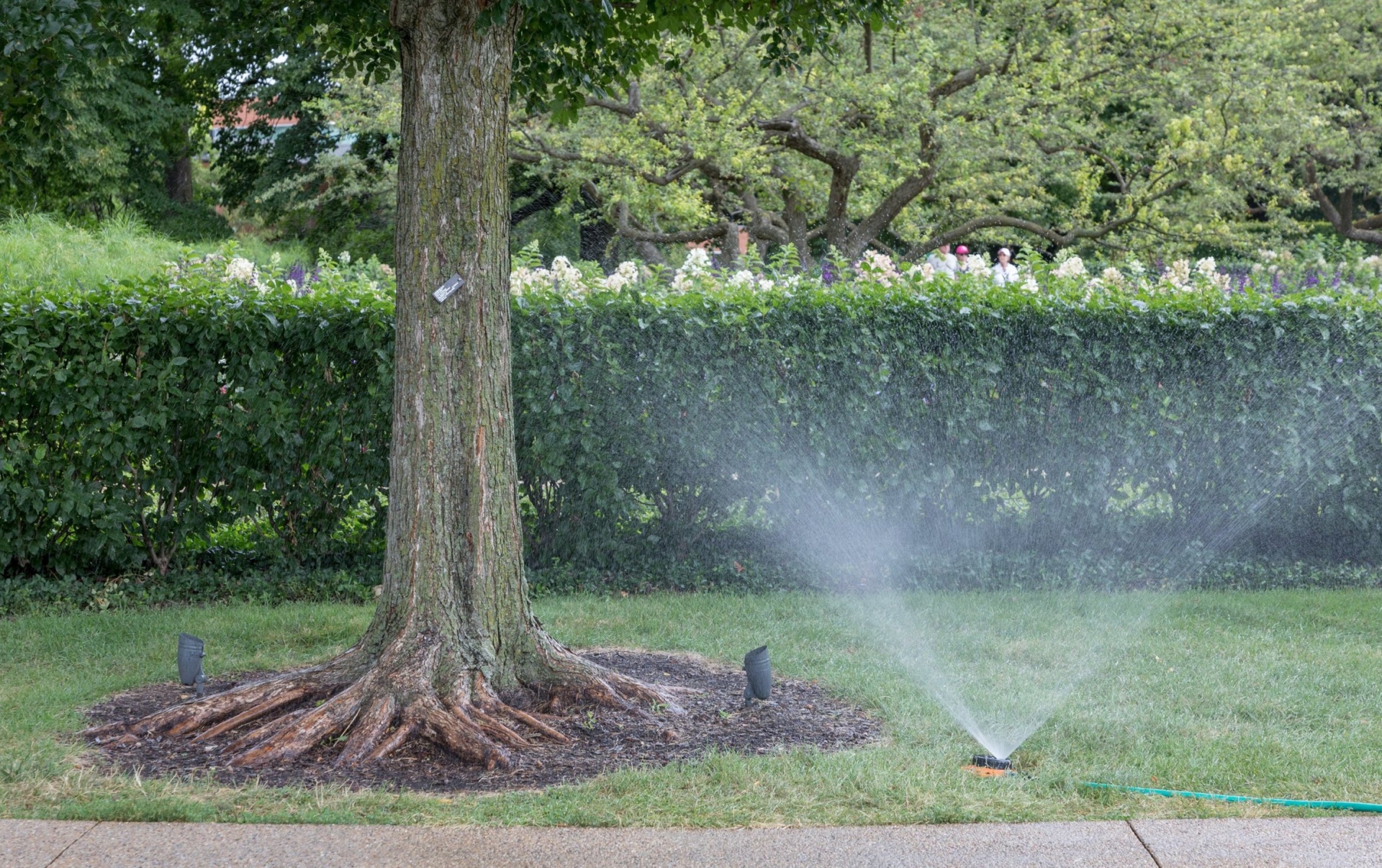
Sprinklers include lawn sprinklers that can be placed in different locations on the lawn or in the garden, as well as permanent in-ground sprinkler systems. Both can be useful tools for watering, but they do have to be used correctly.

How to Water Properly with Sprinklers

Since sprinkler systems throw water up into the air, there is potential loss of water to evaporation. In some situations (high winds and/or dry air), this can be a substantial loss. If water pressure is high, water may be delivered faster than the soil can accept it. That can lead to runoff and loss of water into storm drains. Improper placement of sprinkler heads can send water off-target, to land on driveways and streets instead of planted areas.

To combat these problems, be sure that the sprinklers are placed so that they water the landscape and lawn. Avoid turning the water pressure up too high. Observing the sprinkler system while it is running can help you to evaluate if the water is going where it should. Use the sprinkler when wind speeds are lower, to reduce loss to evaporation.

When using an in-ground system that is on a timer, turn it off on days when rain is falling and water is not needed. In addition to turning the system off on rainy days, also be sure to set the timer properly. Often, systems are set to run about 15 minutes per zone, every second or third day. That is not going to provide the deep watering that plants need and may actually be wasting water. Having the sprinkler run for 15 minutes may not wet the soil deeply at all, and certainly will not provide the suggested amount of water (5 to 6 inches deep in the soil).

The old-fashioned method of putting a can out to collect water still works. An inch of water in the can means that there is enough water to penetrate into the soil 5 or 6 inches. Set the sprinkler system to run less often (maybe every five to seven days, depending on weather) and for a longer period of time. Using a can to test the amount of water delivered by your sprinkler system can give you an idea of how long to run the system at your house. This test only needs to be performed once.

Sprinklers provide overhead watering and wet the foliage of plants. When using a sprinkler of any kind, avoid watering late in the day when water on the foliage won’t be able to dry in the sun. Foliage that stays wet longer is more at risk for fungal disease.

Watering Indoor Plants

Watering indoor plants can be very different from watering a garden. These plants cannot be watered on a schedule. Changes in temperature, light, and humidity make that impractical. Watering needs to be done based on the needs of the plant and the conditions in the home.

To determine the needs of the plant, feel the soil. For most indoor plants, water when the top inch or so of soil is dry. For cacti and succulent plants, let it dry out a little deeper, one and a half to two inches, depending on the size of the container and the type of potting mix used. Mixes for succulents often drain very well and the one-inch guideline may be best in that case.

For best care of indoor plants, it is advisable for all plants to be in containers with a drainage hole. Apply enough water so that some of it starts to come out of the drainage hole. Let the plant sit in that water for about 10 to 15 minutes to let the soil soak up what it needs. Then dump out the excess from the saucer.

For larger plants, use a sponge to soak up the excess from the saucer. Don’t water again until the top inch or so of soil is dry.

It is important to water the plant when it needs it, rather than trying to water on a schedule. A constant, small supply of water can lead to shallow rooting. The plant may survive, but it will never thrive.

Thorough watering helps a plant produce a deeper root system and a deeper root system helps a plant grow better.