Plant Care Resources

How and When to Prune Trees

Prune with purpose and confidence using expert, season-by-season guidance to keep your trees healthy.

Content Detail

Pruning trees is the act of cutting and removing branches from a tree to encourage new growth and develop a good structure.

Why Prune Trees?

Pruning should be done with a purpose in mind. In the early years of a tree’s development, pruning is about developing a good structure for the tree to help it grow well and be strong enough to tolerate the challenges of weather. This structural pruning serves to maintain a good shape and size, within the limits of a plant’s normal size range.

The best results are attained through selective pruning, rather than shearing. Selective removal of certain branches allows us to remove weaker branches and maintain those that are stronger. Selective pruning does take more time, but it yields better results. It allows us to make healthier cuts and work with the natural shape of each plant.

Focusing on structure and safety early in the tree’s life means that later in the tree’s life, pruning can be about fixing problems as they arise. These problems can include storm damage, keeping branches clear of structures, and removal of diseased or dying branches. Maintenance pruning of a maturing tree will also include removal of objectionable growth like root suckers, water sprouts, crossing branches, and thorny branches below eye level.

When to Prune Trees

It is important to prune at the right time.

For most deciduous trees, the best time to prune is between late fall, after the trees go dormant (lose their leaves), through very early spring, just as new growth is ready to begin. This time frame makes pruning easier because the structure of the tree can be seen. It is also a time when diseases and insects are dormant and won’t attack fresh pruning cuts.

Pruning in mid- to late winter, just a few weeks before new growth starts, allows for production of callus tissue to be underway early in the growing season. Callus tissue seals the edge of the wound. For most deciduous trees, pruning time can be extended into very late spring or very early summer, but it will be more difficult to see the structure of the tree and diseases and insects will start to be more active.

While trees can be pruned in summer, it is a less than ideal time. Summer is often very hot and dry, and the trees are under stress. Pruning at that time can add to the stress on the tree. If a tree must be pruned in summer, be sure to water it regularly to reduce stress. Pruning in late summer (August and September) should be avoided. At that time, trees are beginning to prepare for winter and are slowing their growth accordingly. Pruning at this time works against

the natural cycle of the tree. Pruning is a stimulus and will promote new growth that may not harden off in time for winter.

Pruning Evergreens

Prune all evergreens, except pine, before new growth starts in the spring. When pruning evergreens, follow the general branching pattern to maintain the natural shape. You can remove dead, diseased, or broken branches anytime.

In most cases, selective pruning (one branch at a time) is better than shearing.

Pruning “Bleeder” Trees

There are exceptions to the general time frame for pruning.

One exception is a group of trees known as bleeders. Some of the trees that belong to this group are:

  • Maple
  • Walnut
  • Birch
  • Beech
  • Hornbeam
  • Yellowwood

Bleeding is an excessive flow of sap that occurs when these trees are pruned in late winter and early spring. The bleeding is unsightly, but it does not harm the tree. It can be avoided by pruning in the coldest part of winter or by delaying pruning until after the foliage has fully emerged in very early summer.

Pruning Oaks and Elms

Another exception includes trees that are prone to serious diseases spread by insects, specifically oaks and elms.

Oaks and elms should be pruned in the dormant season to avoid insect pests that can spread oak wilt and Dutch elm disease, which are very serious and often fatal diseases.

Traditionally, the recommendation was to prune those species between mid-October and mid-April, so pruning can be done when insects are not present. Changing weather patterns are affecting that time frame.

With longer, warmer autumns becoming more common, it is wise to watch the condition of the trees, not the calendar. When trees are losing their leaves in autumn, they are entering dormancy, and that time is safer. For oaks that hold their leaves through winter, watch when other trees are losing leaves to signal dormancy.

Spring weather has always been erratic in northern Illinois, but is more so than it used to be. This makes it more difficult to decide when to end the pruning season for oaks and elms. There is a tool to help with oaks. University of Wisconsin Extension has a thermal model to help predict when the insect that spreads oak wilt may be active. It works for northern Illinois as well as Wisconsin.

Pruning after Storm Damage

A third exception to the general pruning time frame is storm damage. Prompt pruning of storm-damaged limbs and dead branches should be done to encourage wound closure and avoid potential hazards.

While pruning sealants are no longer recommended, if an oak or elm must be pruned in the growing season, a pruning sealant can help prevent the insects that spread disease from attacking fresh cuts.
How to Prune Trees

Though mature trees may need only occasional pruning to remove dead wood, young trees should be pruned regularly to provide strong branch structure for future growth.

Basic Pruning Cuts

To prune well, an understanding of basic pruning is needed, as well as the knowledge of how to make a good cut that will be able to heal properly.

There are two basic cuts that are used in most pruning: heading back and thinning out.

A heading back cut removes only a portion of the branch, cutting it back to a bud or side shoot. That bud or side shoot becomes the next growing point, so take into consideration what direction that growth will take after the cut is made. Try to envision if that new growth will grow outward and keep the canopy of the tree more open, or will it grow back towards the tree or up into the tree and crowd the canopy. Keeping the canopy more open is the desired outcome. That will let light enter the tree to stimulate future bud development and will also let air flow through the canopy to reduce the potential for disease to develop.

Thinning out cuts remove branches all the way to the ground, when done on a shrub. For a tree, a thinning out cut removes a branch all the way back to a main limb, or possibly to the main trunk of the tree.

The removal of an entire branch back to the trunk may be needed if too many branches are coming out of the trunk too close to one another or if they are at risk for crossing each other and causing damage to each other in the future.

How to Make Good Pruning Cuts

Making good cuts is vital to the healing of the cut and the overall health of the tree.

When cutting smaller branches with a hand pruner or long-handled lopper, cut above a bud, close enough so that no stub is left, but not so close that the bud is damaged.

The bud is the next growing point, so it needs to be undamaged. A stub that is left beyond the bud will eventually die back and can become an entry point for diseases and insects.

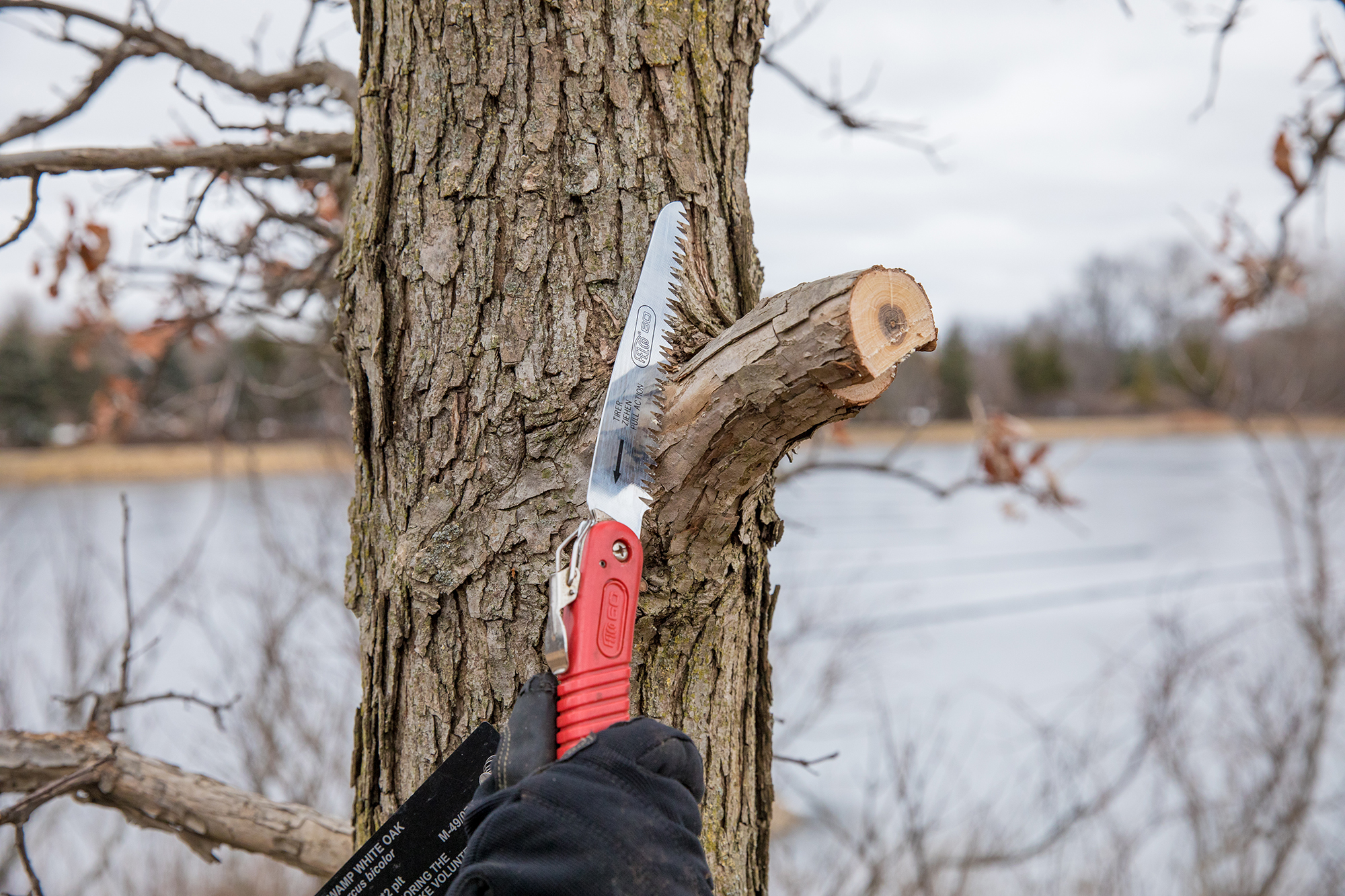
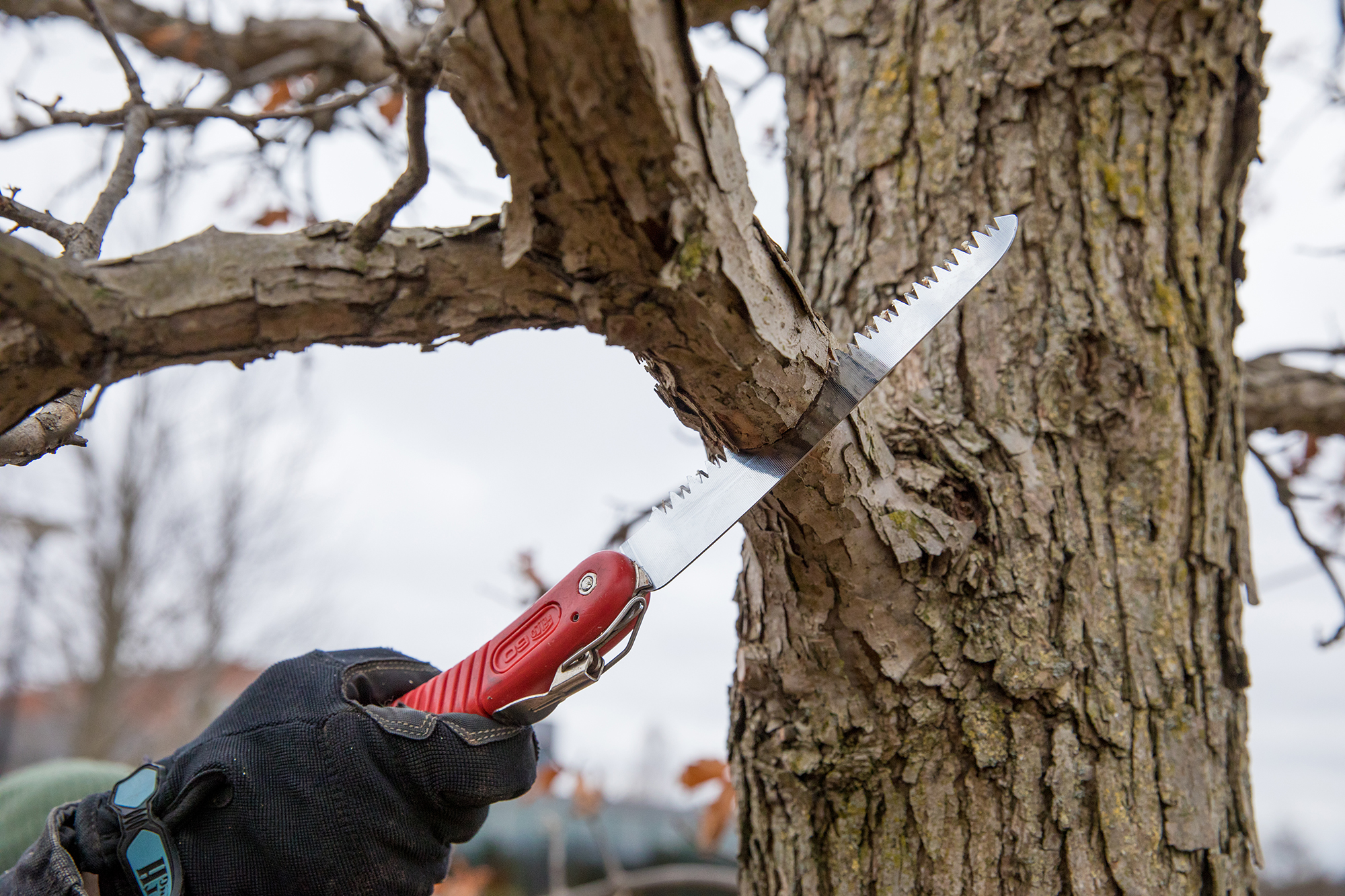
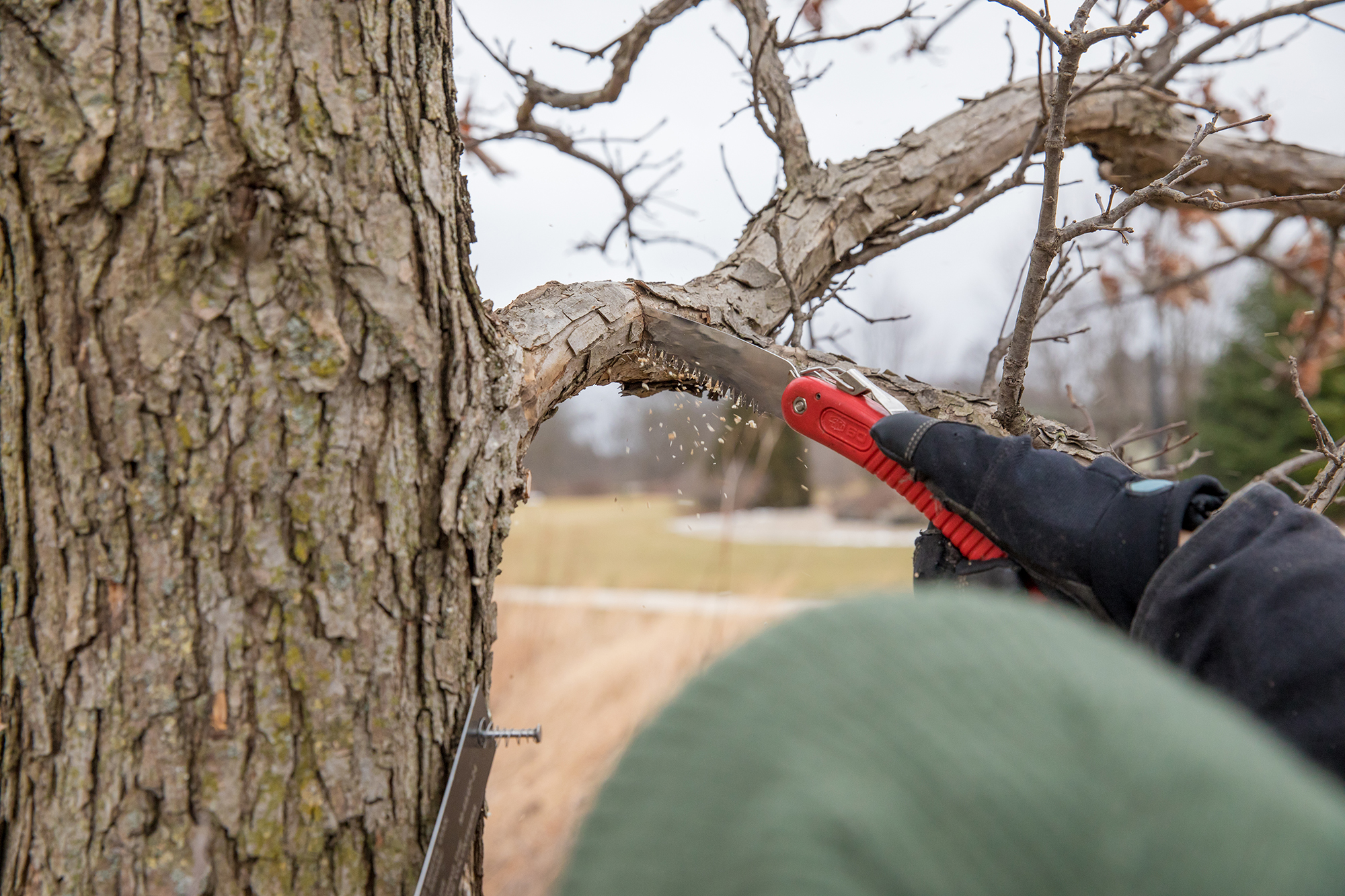
When cutting larger branches with a pruning saw, use a three-step process (see pictures below).

First, cut partially (no more than one-third) through the branch from the underside.

Making the first cut one-third through from below.

Then, make a second cut through the branch from the upper side, a short distance beyond the first. This removes most of the weight of the branch and prevents the base of the branch from ripping bark off the trunk as that base is removed.

Making the second cut through the branch from the upper side.

The third and final cut is the most critical. This final cut is made where the branch arises from the trunk at a swollen area known as the branch collar.

The final cut should not be made flush with the trunk. This results in a very large wound and a greater possibility for poor healing and the introduction of decay.

Instead, place the saw just outside the branch collar. This leaves a smaller wound and retains the branch collar. The branch collar contains the tissues that are most beneficial to the healing process.

Making the third and final cut at the branch collar, the swollen area where the branch arises from the trunk.

Pruning paints or sealants are not recommended, except when pruning oaks and elms in the growing season. In those cases, the sealant should be applied immediately after the cut is made. This prevents insects that can transmit serious diseases from coming to the cut.