There Are Many Ways to Be a Flower
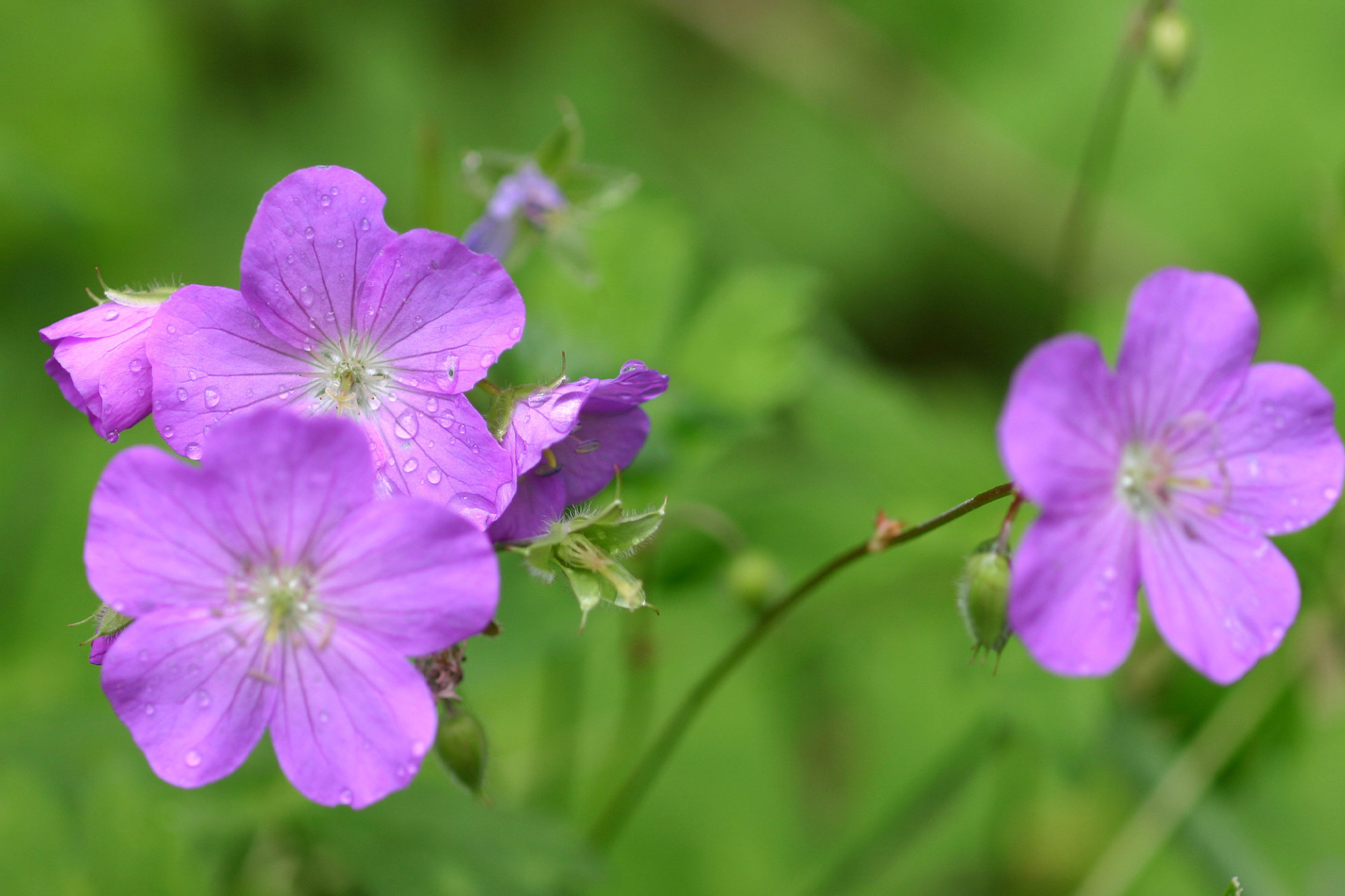
When plants such as wild geranium (above) bloom in the woods, gardens, and prairies of The Morton Arboretum, lifting our spirits is just a side benefit. Their real purpose is to reproduce, and they do it in a wide variety of ways. The bright, beautiful flowers we enjoy are actually billboards advertising pollen and nectar to bees, butterflies, and other pollinating animals, which carry male pollen to female plant parts to produce the next generation. But not all flowers are obvious, and not all reproductive structures are, technically, flowers. As you stroll the Arboretum this season, keep an eye out for these plants and marvel at the clever tactics and fruitful partnerships that have evolved to keep plants thriving year after year.
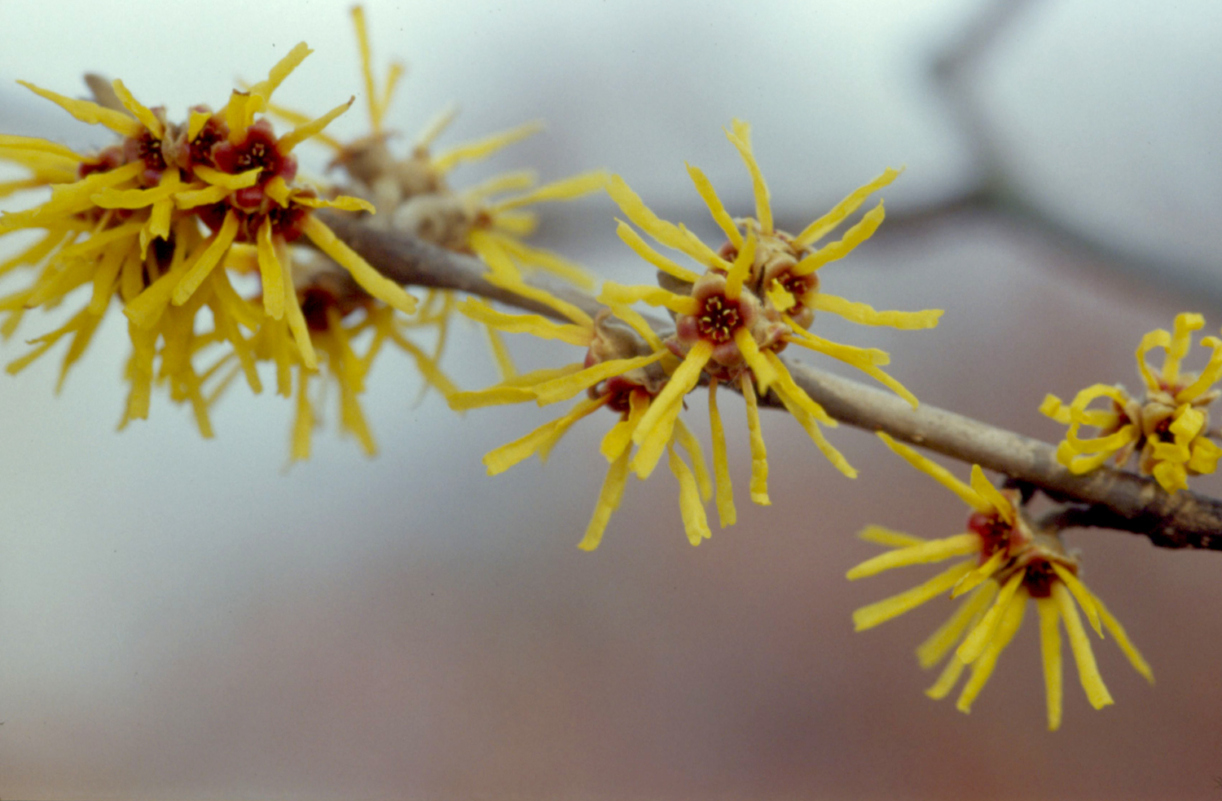
Vernal Witch-Hazel (Hamamelis vernalis)
On a gray winter day, it can be a startling sight: a tree in bloom. Sparkly little flowers flutter along the branches of vernal witch-hazel in late winter or very early spring, sometimes as early as February. Vernal witch-hazel, which comes from the Ozark Mountains to our south, has a close relative, the common witch-hazel (Hamamelis virginiana), native to the Chicago region, that also blooms in cold weather, in late fall or early winter. But why? Conspicuous flowers exist to attract pollinating insects, so why would a tree bloom in cold weather when no insects are to be seen? In fact, a few insects are active in late fall and winter, and if a tree can bloom at that time, it has their full attention. There’s no competition from all the other plants that will be blooming in April and May. Vernal witch-hazel is pollinated by a special group of owlet moths that can warm themselves by shivering as they fly. When common witch-hazel blooms late in fall, there are a few active bees and flies that have limited other food sources. So for these plants, braving the cold pays off: They get their flowers fertilized. You can see several species and cultivated varieties of witch-hazel in the Ground Cover Garden (near the Visitor Center) or in Witch-Hazel Dell (near parking lot P-27).
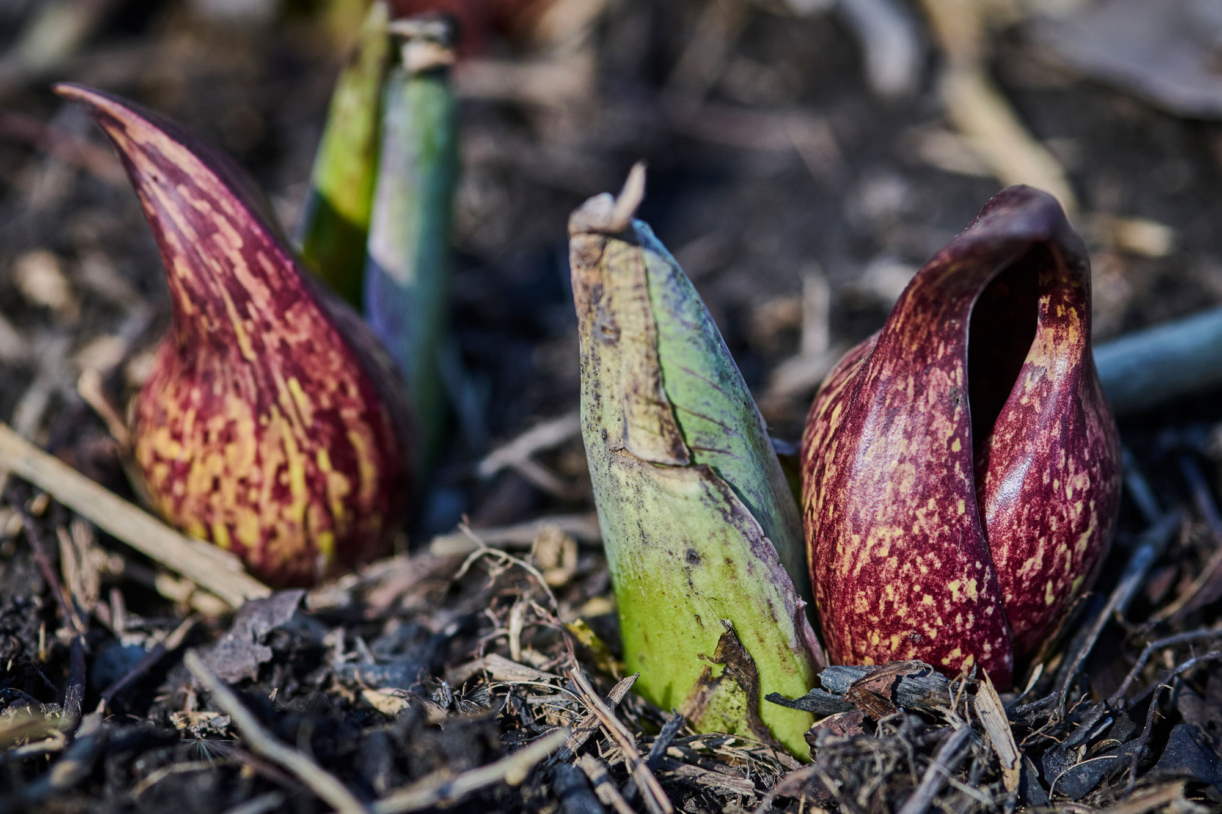
Skunk Cabbage (Symplocarpus foetidus)
One of the first heralds of spring is not a bright crocus or delicate snowdrop. It’s a huge, weird, stinky native flower that has the power to bloom even in the snow. A superabundance of stored enzymes helps skunk cabbage generate its own heat, so it can melt its way to the surface right up through frozen soil. What emerges is a spathe, a thick, fleshy, pointed hood of mottled maroon, roughly the color of raw liver. This spathe covers and shelters the actual flower spike, surrounding it in a little chamber of warm air that is attractive to the first few flies and other insects that emerge early in spring. The other attraction is the scent: a heady aroma reminiscent of rotting flesh. It’s not what we think of as a lovely spring fragrance, but it’s irresistible to carrion flies, the skunk cabbage’s favored pollinators. Skunk cabbage protects itself from being eaten by other early risers, such as deer, by producing a potent toxin. By the time other, less edgy flowers are opening, the spathe and flower spike will wither and a set of broad leaves will emerge. One place skunk cabbage usually blooms is near the dam at the lower end of Lake Marmo (near parking lot P-28).
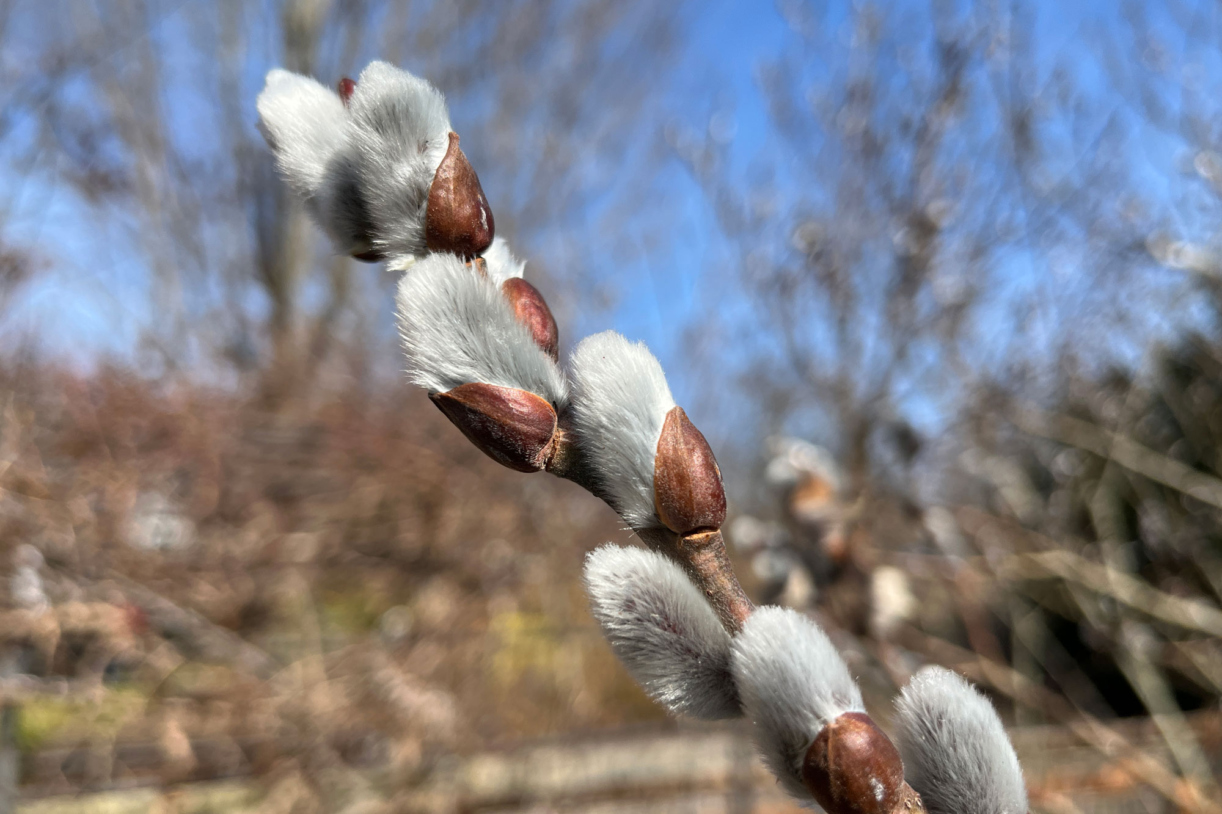
Pussy Willow (Salix discolor)
In late winter, bits of fluff appear along the branches of some willow shrubs, silvery gray and as soft to the touch as a kitten’s paw. That fur is actually insulation protecting flower buds against cold weather until they bloom in late March or early April. The fur balls—found only on male plants—turn into tiny catkins of yellow flowers, rich in pollen and nectar, that are an early-season feast for many kinds of pollinating insects, including several kinds of native bees. The shrubs also host the larvae of 18 kinds of butterflies and moths, including eastern tiger swallowtail and mourning cloak butterflies. A nice pussy willow can be found in the Children’s Garden (near the Visitor Center), and others grow in the Midwest Collection (near parking lot P-2) and other moist areas.
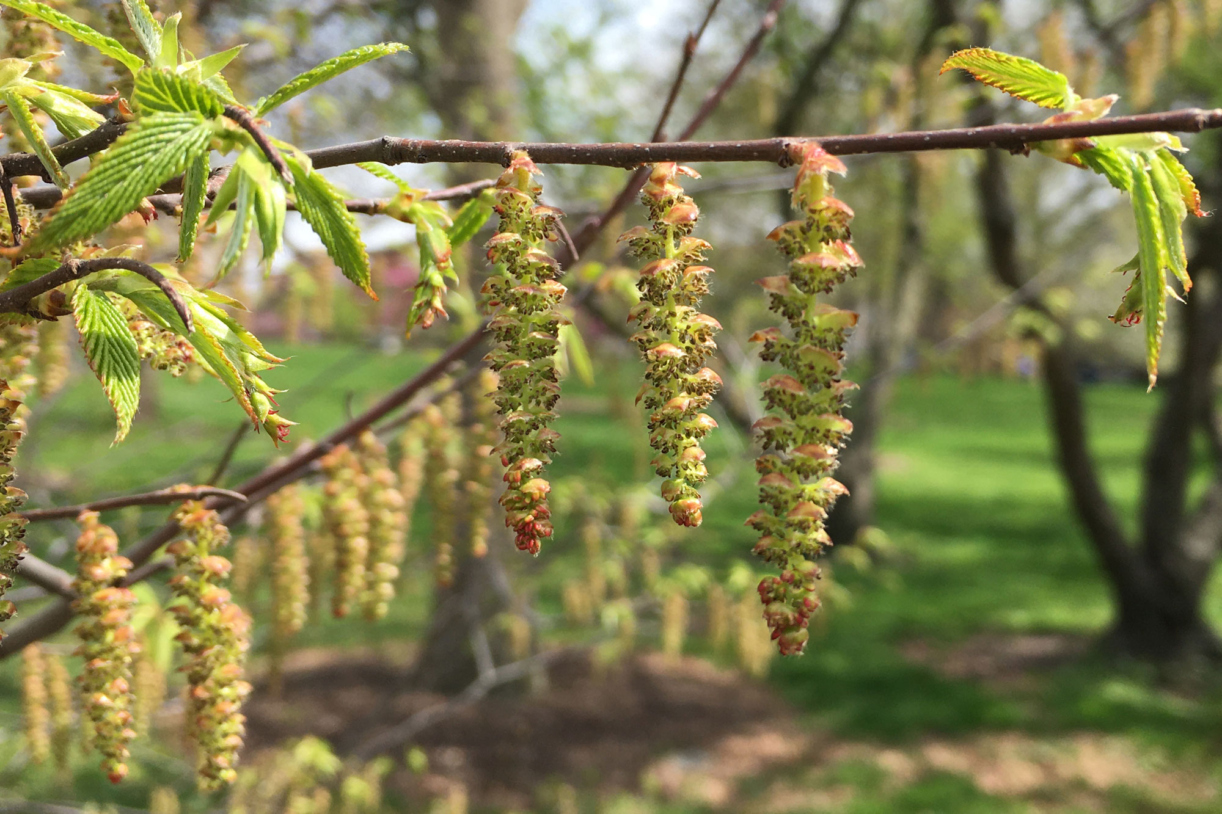
Subtle Tree Flowers
Early spring brings an aura of fresh green or red to high treetops all over the Arboretum and your neighborhood. It’s not the first leaves—those trees are blooming. These maples, like most trees, depend on the wind, not insects, to distribute their pollen from male flowers to fertilize female flowers. Fine as dust, the pollen grains easily ride the breeze, and a lucky few will fall onto female blossoms. Some trees, such as oaks, bear their pollen on delicate, dangling, quivering catkins, the better to release pollen into every passing breeze. Although they produce copious amounts of pollen, these trees’ flowers tend to be small and inconspicuous. They don’t need to be flashy insect lures like those of magnolias, redbuds, and horse-chestnuts. Wind-pollinated trees usually bloom before their leaf buds open so leaves don’t get in the wind’s way. Rain can wash pollen grains to earth before they land on a female flower, so there tend to be more maple seeds or acorns after a dry spring than a rainy one.
Yellow Bird Magnolia Blooms (Magnolia ‘Yellow Bird’)
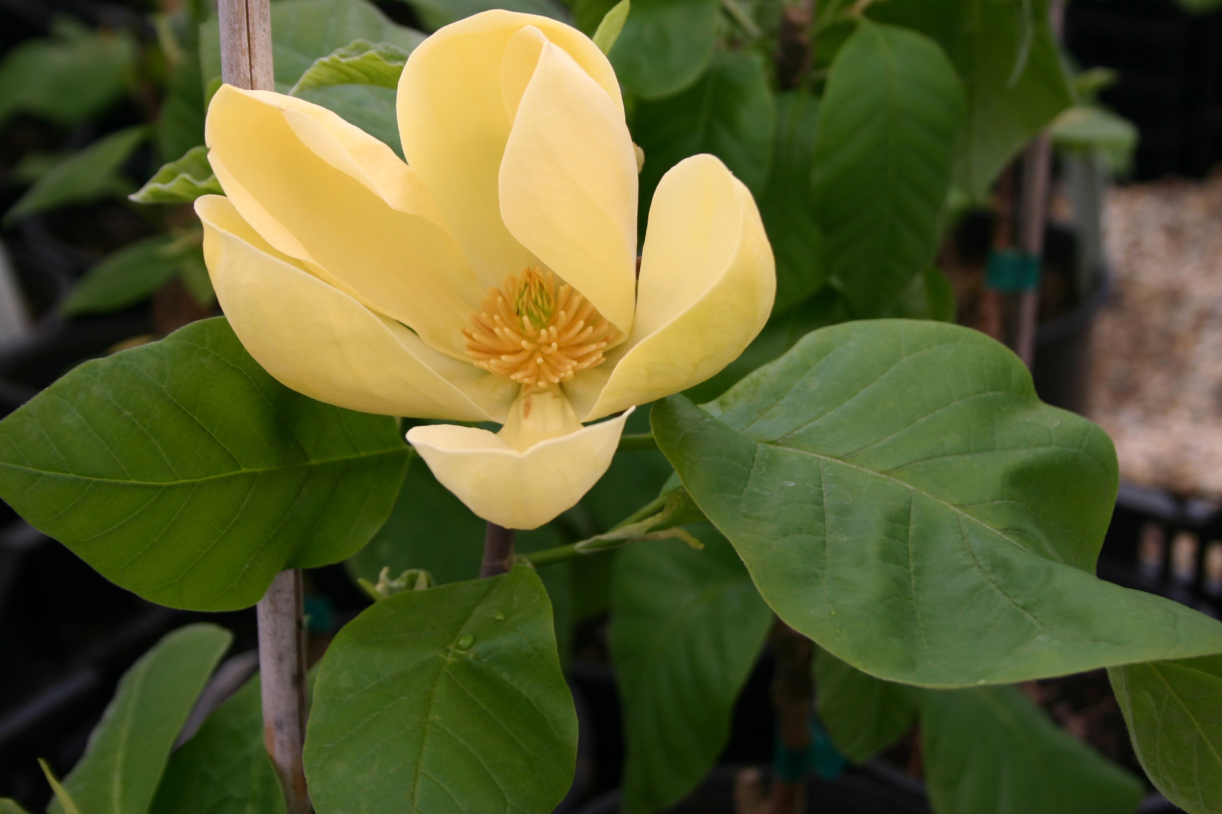
The architecture of magnolias’ huge, simple, sturdy blooms reflects their origins as some of the oldest flowering trees. When they were evolving 100 million years ago, the only insects available to provide pollination services were flies and flightless beetles—bees and butterflies were yet to come. A magnolia flower is built to make it easy for a slow, trudging beetle, attracted by its fragrance, to climb up and seek its nectar. The broad petals are beetle-sized and thick enough to support the weight. The pollen-bearing stamens stick right up in the middle, where even the clumsiest beetle can readily brush against them and then trudge away, pollen-dusted, to fertilize another bloom. Look for a variety of magnolia trees all around the Arboretum, especially in the Magnolia Collection (near parking lot P-5).
Wild Ginger (Asarum canadense)
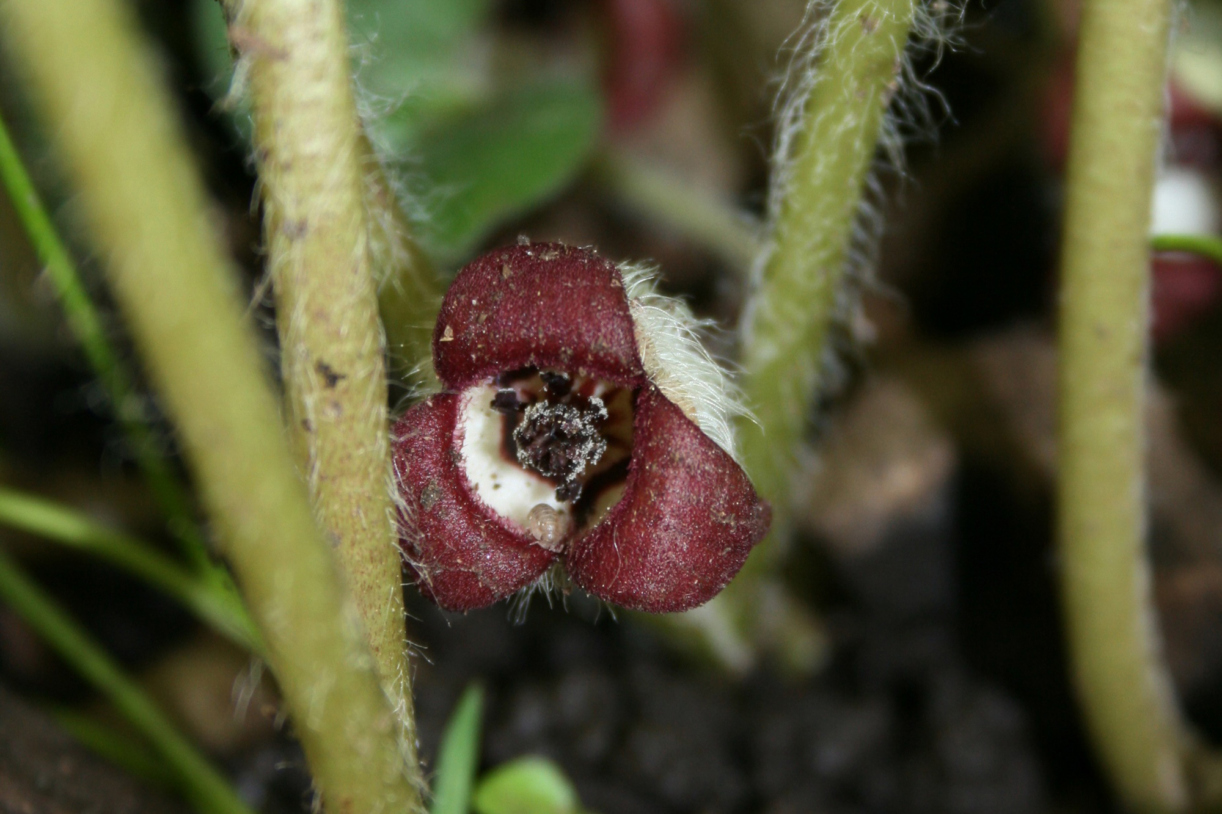
You’ll have to hunt under the heart-shaped leaves in April and May to find the flowers of wild ginger, a native plant that grows in moist, shady places in the woods. The bell-shaped maroon blooms lie right on the ground, the better to be reached by the ants that are the plant’s partners. Wild ginger can spread into large colonies by sprouting from underground stems called rhizomes, but to take root anywhere farther away, it needs ants. After blooming, the flowers form pods full of seeds, each with a fatty appendage called an elaiosome that is an ant treat. Ants drag the seed back to their anthills, eat the elaiosome, and discard the seed nearby, which has the effect of planting it. (Note: Wild ginger is not related to the ginger we buy at the grocery store and is considered toxic.) Look for wild ginger in the East Woods (parking lots P-8 through P-14).
Table Mountain Pine (Pinus pungens)
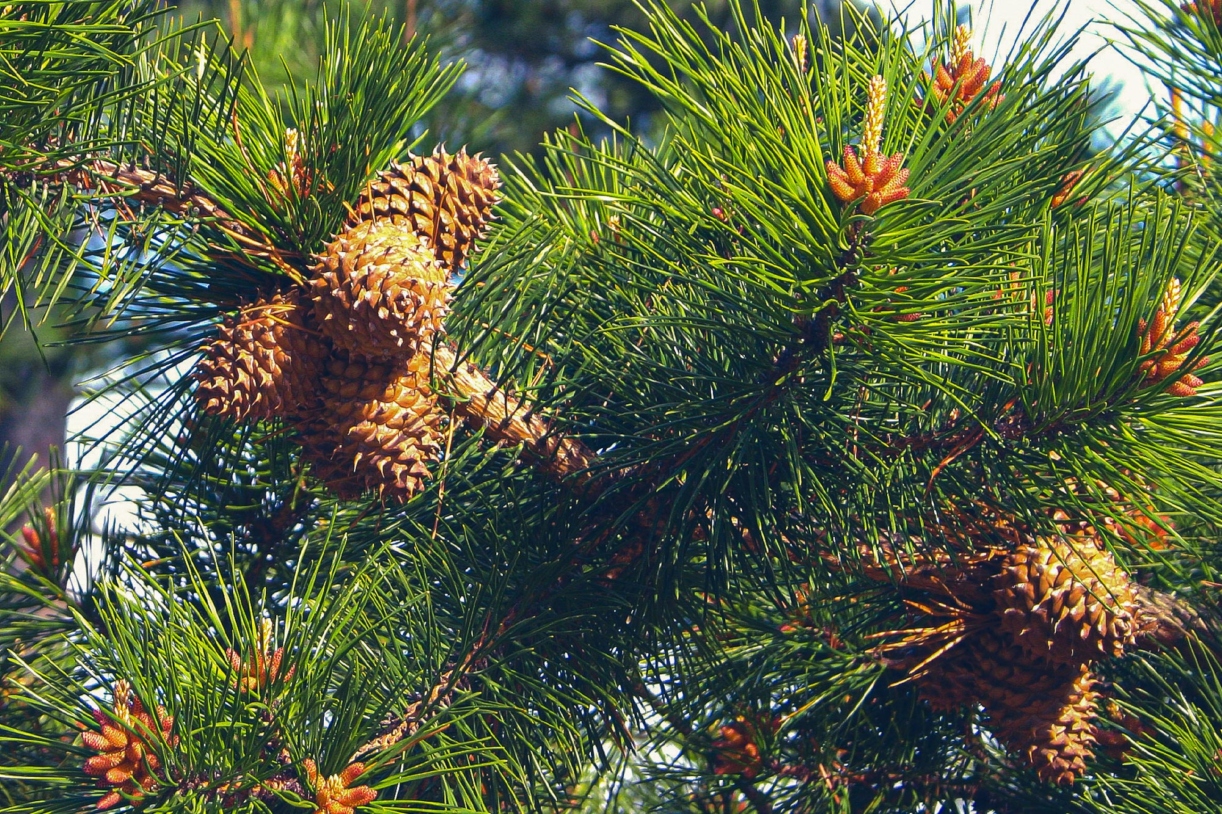
Conifer trees and plants such as pines, spruces, and firs don’t have flowers, exactly. But they do reproduce sexually, and to do that, they have two kinds of cones that you may see on their branches in spring. The female cones, which are usually higher up, look more or less like stereotypical pine cones, although their scales are sealed up tight. The pollen-laden male cones, found on lower branches, are often more brightly colored and can appear more like brushes or bundles of fluff. Male cones may release clouds of yellow pollen on a windy day in spring. To avoid being pollinated by the same tree, the female cones will wait a while before they admit a single fertilizing pollen particle underneath each scale. Fertilized cones stay sealed up, often for years, while the seeds develop under the scales. For example, in the Table Mountain pine, an Appalachian species, a cone often takes five to seven years to mature. Finally, when the cone is ready, it will dry out and its scales will separate, allowing the winged seeds to drop out. Many will be eaten by animals, but a few may fly far enough and land in the right place to grow into new trees. See many kinds of conifers along the Conifer Walk (parking lot P-1).
Virginia Waterleaf (Hydrophyllum virginianum)
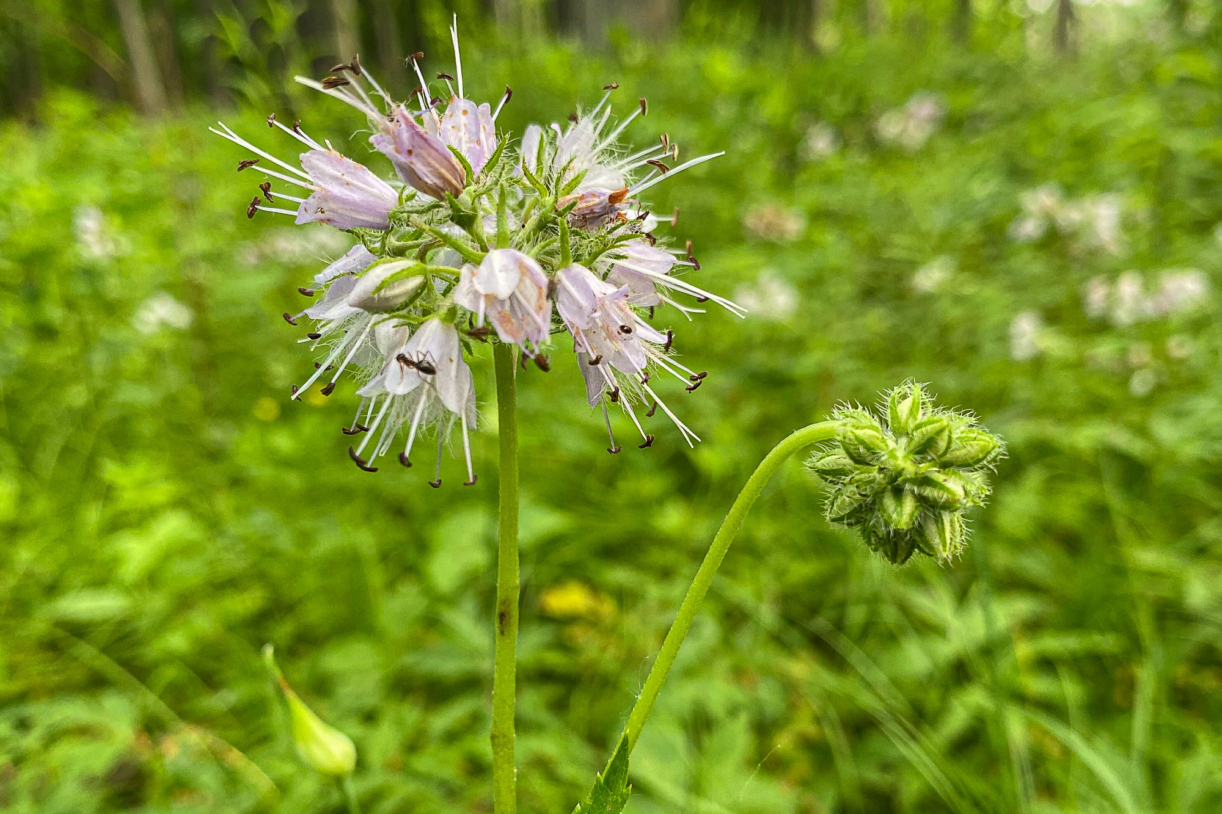
The pale purple of a wild geranium’s flower is a good bet for attracting bees as well as butterflies. Bees see in the ultraviolet end of the color spectrum, so they can’t see red, which is at the other end. But shades of purple stand out vividly for them. Purple is also attractive to butterflies, which can see a wider range of colors than bees. The geranium flower’s wide-open structure makes its pollen and nectar available to a variety of insects, in contrast to the tube-shaped flowers of some plants that require specially-adapted mouthparts. Wild geranium, which blooms in May, attracts many of the more than 400 species of native bees in Illinois, as well as butterflies, moths, bees, wasps, beetles, and non-native honeybees. A few months after a wild geranium flower is fertilized, it turns into a long, spiky seed pod. When the pod ripens and pops open, it can shoot the seeds up to 30 feet, helping to spread geraniums through the woods. You can see wild geranium in many places at the Arboretum, including the East Woods.
Big Bluestem Flowers (Andropogon gerardii)
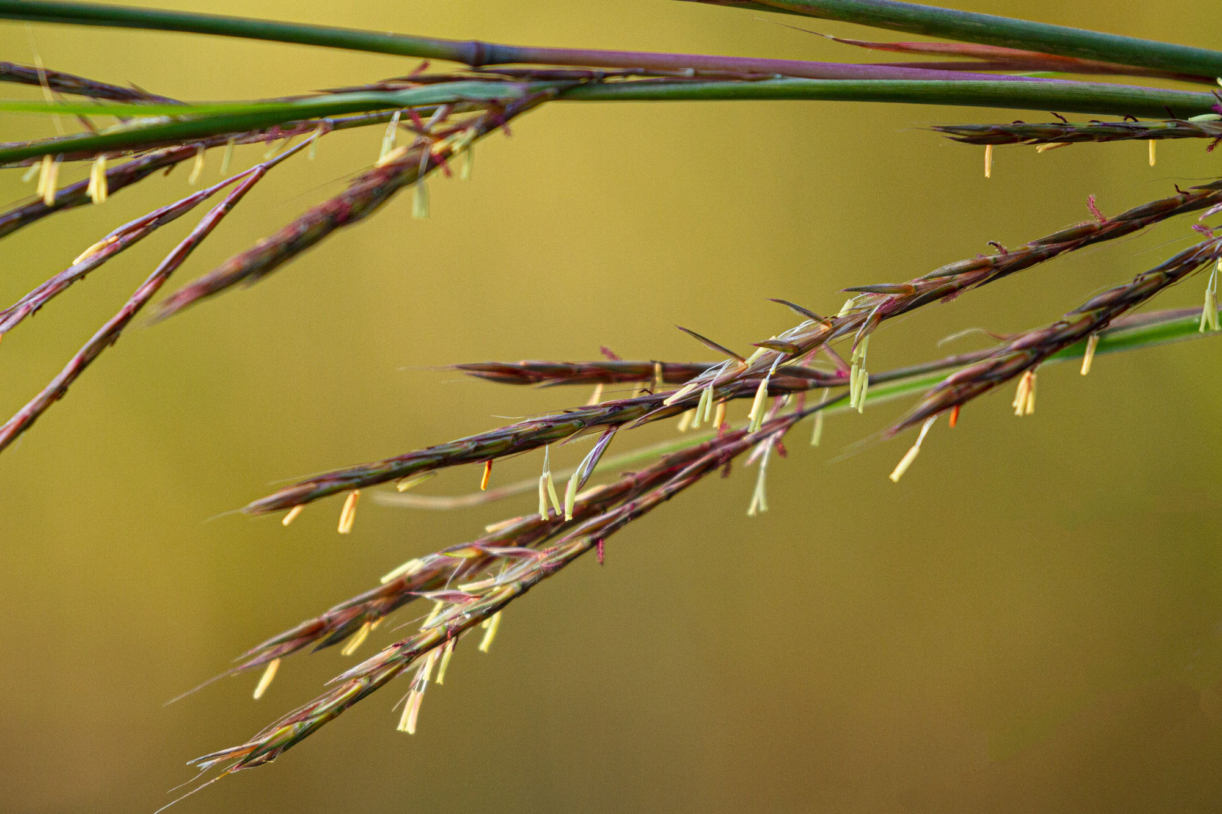
Most grasses in the Arboretum’s prairies, including big bluestem, wait to bloom until late summer or early fall. Since they’re wind-pollinated, grass flowers can afford to be subtle. Still, in August you can spot big bluestem flowers growing like orange beads in a row down the tips of the stems. The plants’ backup reproduction strategy is to sprout from underground rhizomes, developing thick clumps and mats of roots over time. Examine grasses for flowers in late summer and early fall in the Schulenberg Prairie (parking lot P-25).