A Tough American Tree Gets Help from Arboretum Science
In late summer, the round, lime-green fruits of black walnuts are everywhere on Illinois trails. If by chance you should spot something a little different—a little more yellow, a little more lemon-shaped, a little fuzzier—you might have found something rare and precious: the fruit of the endangered butternut tree.
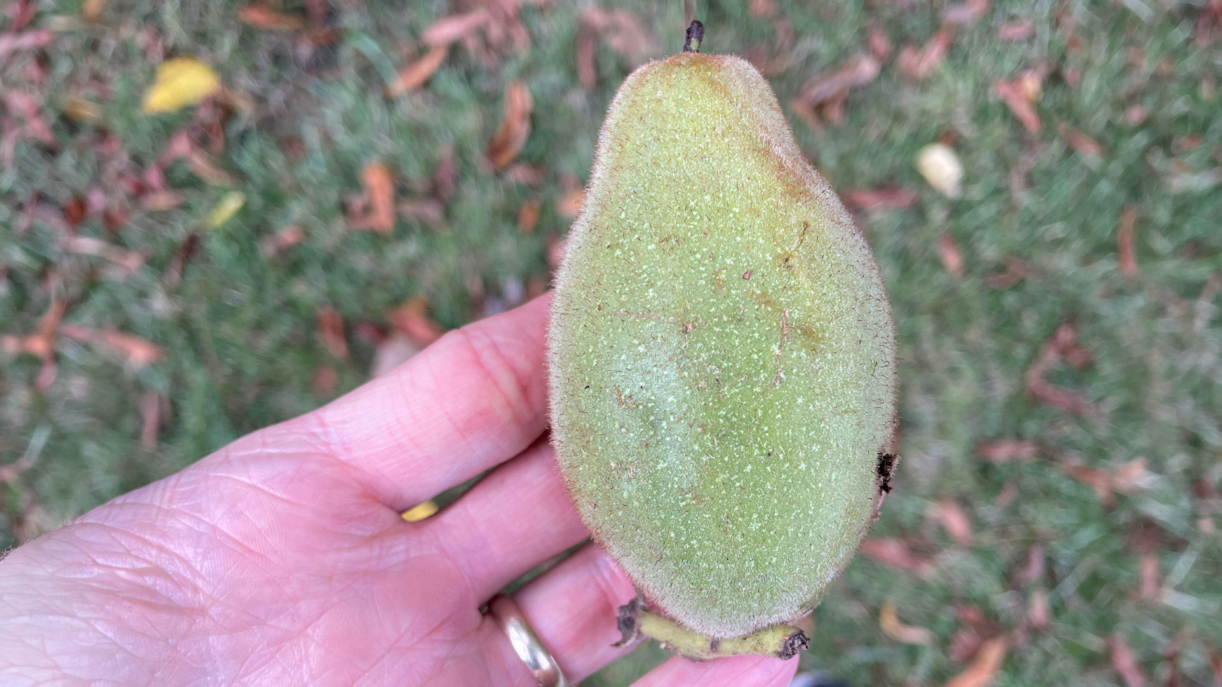
Fruit of the butternut tree (Juglans cinerea)
This native tree species, once common in the upper Midwest and Northeast of the U.S., has been devastated by butternut canker, a lethal, ubiquitous fungal disease that is estimated to have killed 90 to 95 percent of butternuts since the 1960s, when researchers believed it traveled here from Asia. Now, scientists from The Morton Arboretum are trying to give the species a better chance by investigating genetic and environmental factors that might help butternuts survive the disease, and even thrive.
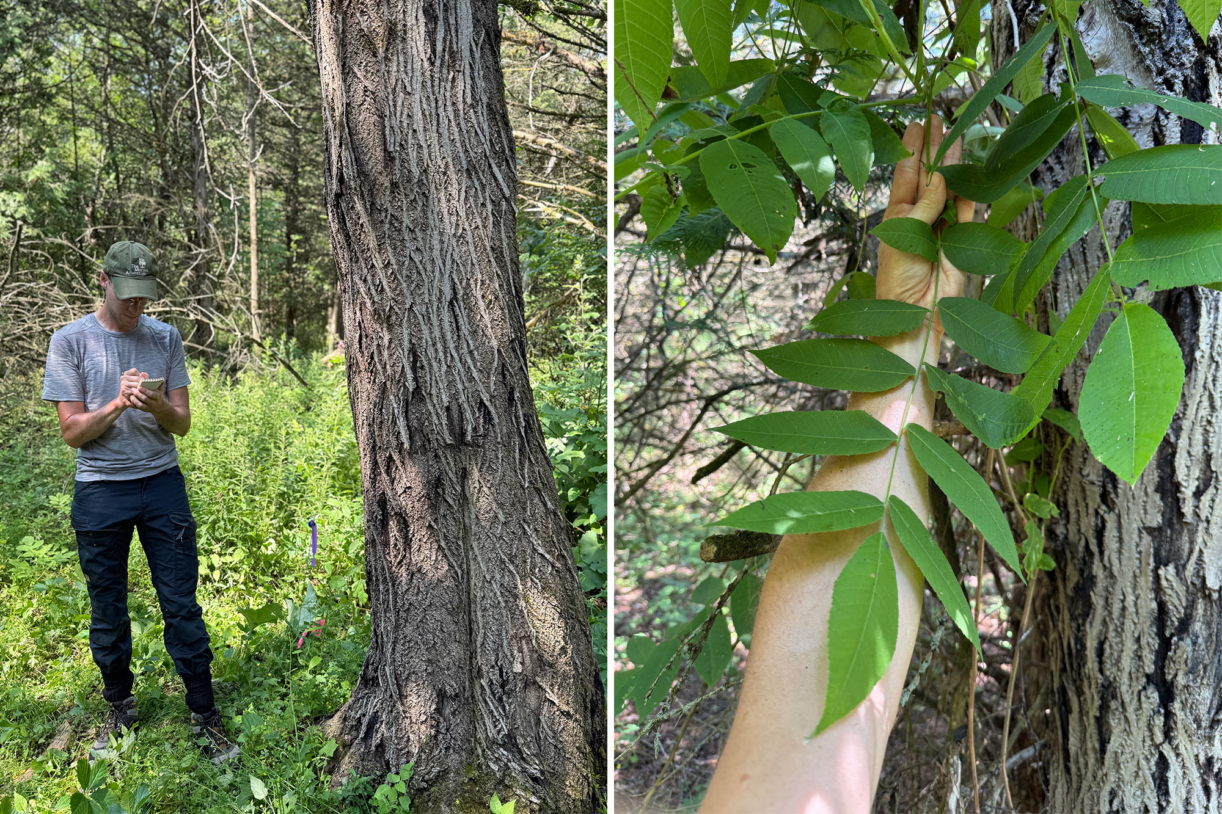
“It’s a very vigorous tree if it’s in the right conditions,” said Sean Hoban, senior scientist in the Arboretum’s Tree Conservation Biology Research Program (shown at top). “We’re trying to figure out the source of that resilience.”
Hoban and Emma Leavens, tree conservation biology program manager, are working with partners in Illinois, Wisconsin, Vermont and elsewhere to find surviving butternut trees and seedlings to answer questions that may be critical to the trees’ future. What they learn through their efforts helping butternuts may also be important to the conservation of other endangered trees.
The Arboretum’s scientists have found seedlings and a few surviving trees on both private and public property, including at the Arboretum and in Chicago-area forest preserves, and are hoping that members of the public may help them locate more. (You can help through their partnership with Adventure Scientists.)
The fatal impact of canker disease is typically gradual. Fungal spores that land on the bark cause deep wounds in the trees’ trunks and branches that eventually cut off the flow of nutrients and water, leading to death over years or decades. “That slow death gives us time to investigate why that individual tree survived so long,” Leavens said.
When the team finds small seedings, one initial thought is, “where is the parent tree?” A butternut has to be 10 to 15 years old to reproduce, so if there are seedlings, some trees must be resisting the cankers long enough to mature. Why? Are they genetically tough? Or are they growing in conditions that are especially good for butternuts? Or both?
To try and resolve those questions, the team takes samples for genetic testing. DNA can reveal which wild-growing seedlings are pure butternuts or hybrids crossed with non-native Japanese walnuts. The researchers also hope that when they have tested enough butternuts, they will be able to discern how genetics influences butternut survival and how much of the species’ genetic diversity survives.
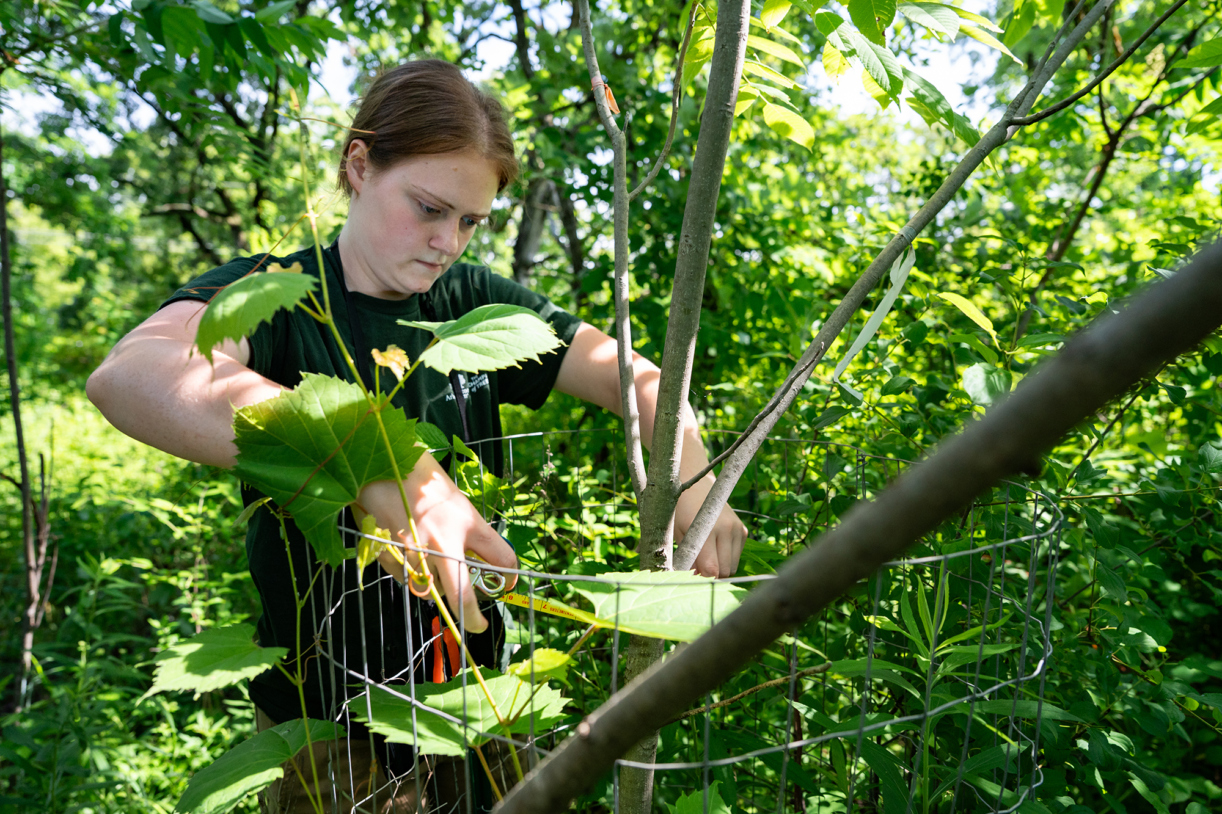
Butternut seedlings are carefully measured and recorded, and where possible, protected from hungry deer.
Wood from some of the few surviving mature butternuts gets grafted onto rootstocks of the closely related black walnut to preserve their genes. “Those trees that still exist now have survived the disease for a long time,” Hoban said. “Grafting is a way to propagate their history and their resilience at the end of their natural lifespan.”
Most of the work so far is on seedlings. They are carefully measured and described so they can be followed to observe their growth and their growing conditions.
Butternuts (Juglans cinerea, a near relative of walnuts) are a pioneer species—hardy, fast-growing trees that are planted on barren or disrupted land to start the natural healing of an ecosystem. Historically, they grew along streams and forest edges, and took advantage of openings when old trees fell to let sunlight into the woods. Collecting data about where seedlings are springing up, and how well they do in different places, may show whether the trees’ habitat affects their health and how well they withstand the canker disease.
“Ultimately, this is to understand what we can best do and what are the best kinds of actions we can take to support these trees,” Leavens said. “Where can we plant butternuts so that they are more likely to do well?”
For years, the work of Hoban and his colleagues in the Tree Conservation Biology Research Program has supported the conservation of rare and endangered trees by developing a quantitative basis for optimally conserving genetic diversity in botanic gardens. For example, their work has made it easier to estimate how many individuals need to be saved in the wild, in a public garden, or in a seed bank to safeguard the genetic potential of a whole species.
That research has supported biodiversity conservation worldwide, including projects of the Arboretum’s Global Tree Conservation Program. But a few years ago, Hoban decided he wanted to apply his knowledge to the hands-on work of conserving a single species.
Why butternuts? Because they are native to the Chicago region and are entwined with human history. For many centuries, creamy, mild-flavored butternuts were a protein-rich food for Indigenous people and settlers. The tree’s fine-grained wood is prized by woodworkers. At the Arboretum, Hoban can see butternuts grow and change without having to travel far.
He and Leavens are among dozens of people across the trees’ native range involved in the Butternut Tree Restoration Initiative: landowners with butternuts on their properties, restoration managers, forestry researchers, pathologists, and breeders trying to select resistant trees or hybrids.
The Arboretum’s share of the effort focuses on collecting and analyzing data to understand why butternuts respond the way they do to canker infection over time. Many questions about canker disease remain to be answered: Once the spores land on a tree, how does it travel through the tree’s system? Does it affect only the bark where a fungal spore lands? Does it infect the seeds produced by the tree?
“There’s a lot of potential for further work on butternuts, and no end to questions,” Hoban said. “I think we’ll start to make a big impact on the survival of butternuts in the next five years or so, but I could be contributing to butternut conservation and restoration in my 80s.”
That kind of long-term commitment to the practical science of trees is made possible by Arboretum donors. Their ongoing support makes it possible for Arboretum scientists to tackle research questions across decades.
Where possible, the Arboretum’s work includes collecting butternut seeds to be grown into trees that may eventually lead to reintroduction in places that have lost their butternuts. Eight years ago, Hoban and Kim Shearer, director of collections and curator, explored the woods of North Carolina and collected butternut fruits. Trees grown from those nuts are now planted in the North America (East Side, parking lot P-16) and Walnut Family collections (West Side, parking lot P-31).
“It’s the first time I can see trees I helped collect growing in the Arboretum’s collections,” Hoban said. Now, the task is to figure out how to help them stay alive.