Summers of Science Open Up Careers
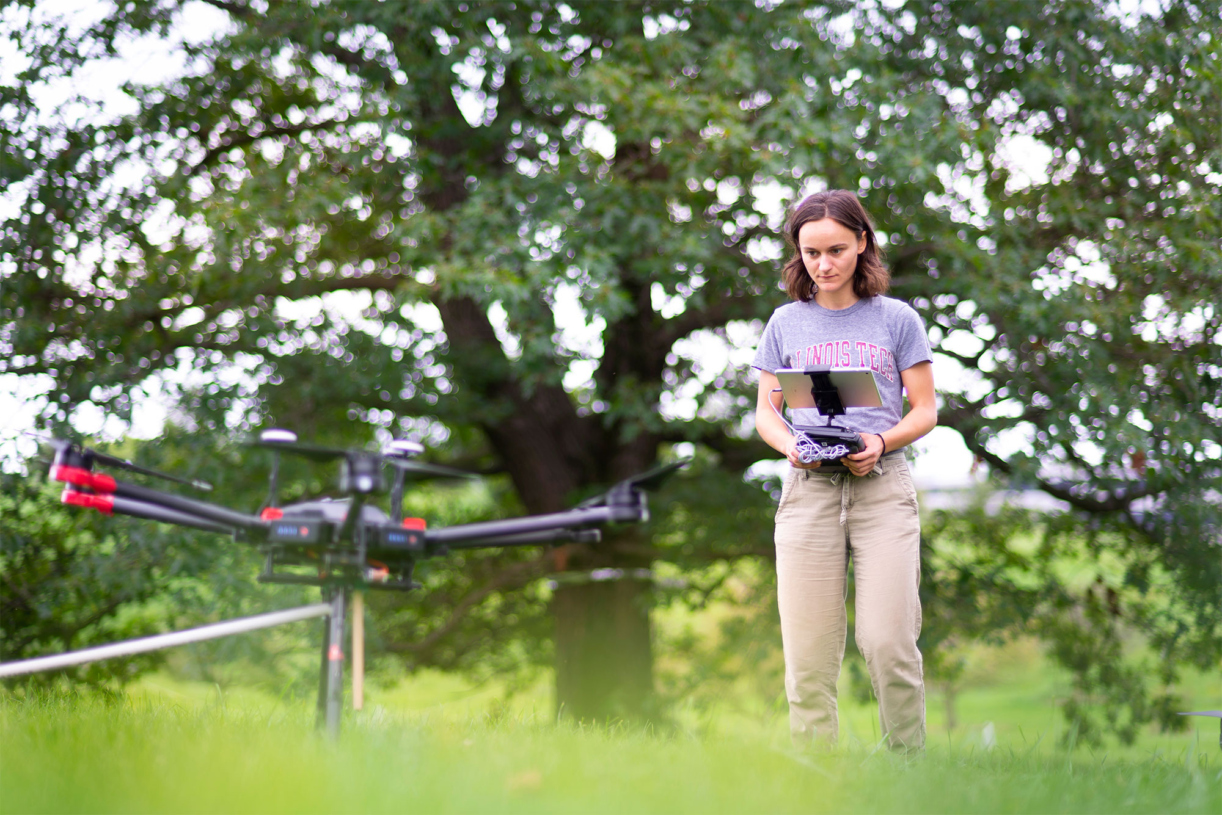
Sydney Kaplan remembers one oak tree at The Morton Arboretum almost branch by branch. For weeks, she flew a drone up and around it, trying to perfect a way to use the craft to harvest leaf samples from high in the tree’s canopy.
Kaplan (above) was a mechanical engineering student and aspiring roboticist from the Illinois Institute of Technology, spending the summer of 2019 in the Research Experiences for Undergraduates (REU) program—one of the major ways the Arboretum encourages and supports future scientists. It was an opportunity to take what she had learned about engineering and work with Arboretum scientists to apply it in a field project that could help the field of biology and the environment. “Robotics with a purpose,” she said.
That drone leaf harvester never did work very well, but one of the lessons of research is that not everything turns out the way you expect. Still, her REU experience led her, via a later project with apple-picking robots in New Zealand, to her current job as a systems engineer at Amazon in Seattle, working to develop robots with a sense of touch. “The REU program led directly to the opportunities that I have today,” Kaplan said.
The program is one of the ways the Arboretum encourages young people to consider or advance in science careers, especially tree science. “One of our main goals is to make sure there is a pipeline of new researchers entering our field,” said Meghan Midgley, PhD, director of the Center for Tree Science and a scientist who leads the Soil Ecology Research Group.
In the REU program, roughly eight undergraduate students are provided with housing and a stipend for a 10-week summer internship every year, each working with a designated mentor among the leading researchers in the Arboretum’s Center for Tree Science.
“Our mentors and our program work together to ensure students are not only gaining technical skills, but also broad perspectives about being a professional in tree- and science-related fields, to set them up for success in whatever career path they choose,” said Christy Rollinson, PhD, the Arboretum’s senior scientist in forest ecology, who currently co-leads the program.
“We emphasize holistic development of student skills and abilities as researchers,” said Christine Carrier, the program’s manager. Each student designs a research project related to their mentor’s field, does the fieldwork, and analyzes the data. The session culminates in a symposium where the undergraduates present their work.
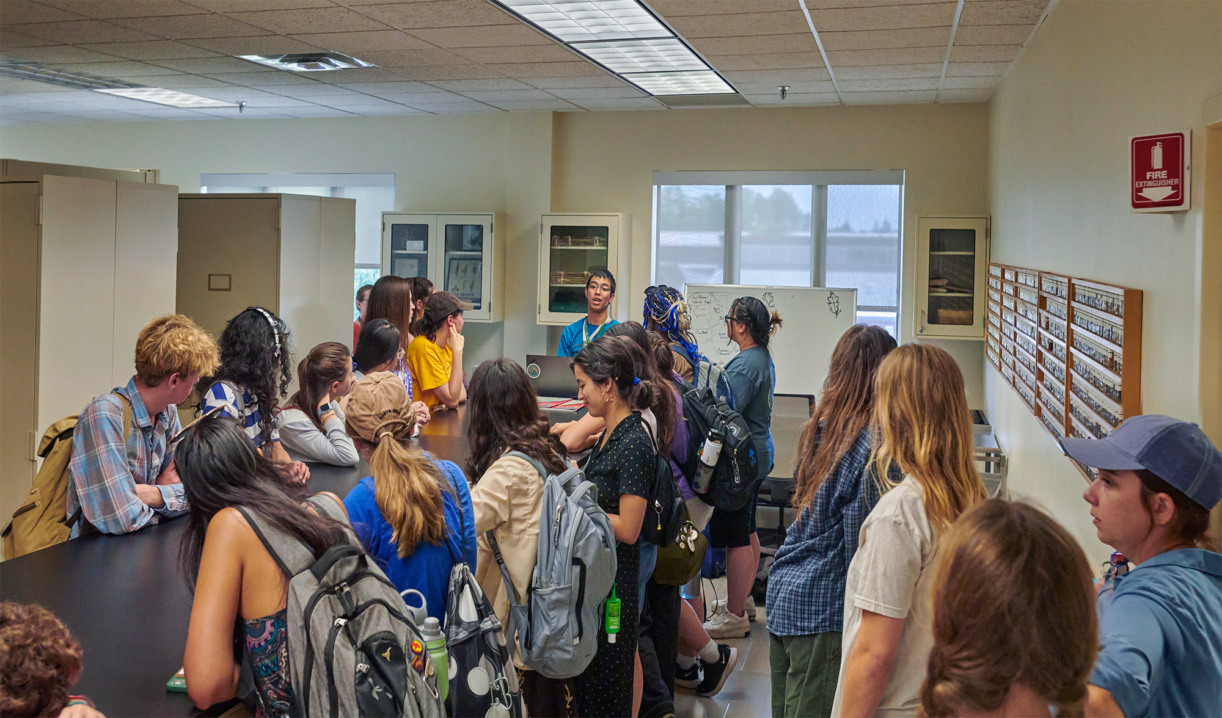
Students have chances to connect with each other and with peers from other institutions, such as this session with interns from the Chicago Botanic Garden visiting the Arboretum’s Herbarium.
“It’s really rare to have a program that supports undergraduate students to do their own research projects,” said Janey Lienau, now a PhD candidate at Yale University who hopes to become a professor of ecology.
Her REU opportunity in 2020 was critical to her career because her small college had limited research opportunities. “I just really enjoyed the whole process of research and it gave me a taste of what it would be like,” she said. She is one of a number of undergraduates whose REU research has led to published scientific papers.
Without the Arboretum experience, data analysis would be far more intimidating to me.
From her REU experience in 2019, Gabriela Krochmal learned data skills that serve her well as a research technician at the Metropolitan Water Reclamation District (MWRD) in Chicago. She was a Loyola University senior when she went to Costa Rica with her REU mentor, Silvia Alvarez-Clare, PhD, director of the Global Tree Conservation Program, and analyzed 10 years of tree growth data, studying the effects of soil nutrients. “It was all about using messy real-world data to reach meaningful conclusions,” she said. “Without the Arboretum experience, data analysis would be far more intimidating to me.”
The REU program is part of the Center for Tree Science’s Integrated Mentorship Program, which offers a variety of ways for undergraduate and graduate students to explore and pursue careers in tree science and other research.
It’s a prime example of the power of the Arboretum’s donors to propel the organization’s mission. A precursor to the REU program was supported by a generous private gift from 2014 to 2018. During that time, according to Carrier, 31 undergraduates spent summers designing and completing research projects with staff mentors. Their work led to more than 40 scientific presentations at other institutions and 10 published scientific papers. In 2019, federal funding enabled the Arboretum to integrate the initiative into the National Science Foundation’s nationwide Research Experiences for Undergraduates program.
Former REU students say the Arboretum’s program and its researchers stand out. “They have so much mentoring energy,” Lienau said. “It’s not just your immediate mentor. The whole department, together, mentors all the students. That’s really special.”
She suspects it’s because the Arboretum is a research institution and not a teaching institution, like a university. “All their mentoring energy seems to go into the REU program,” she said.
“I love research,” said Midgley, who worked with Lienau in her REU summer. “But I gain so much fulfillment as a mentor from helping other people grow and seeing other people’s success.”
It’s not just your immediate mentor. The whole department, together, mentors all the students. That’s really special.
Several students said they loved the opportunity to be outdoors in nature to do fieldwork, not only working in a lab. Another strength of the Arboretum’s program, they said, is the breadth of the training it offers, including learning how to write effective academic papers, improving presentation skills, and discovering visual ways to share data.
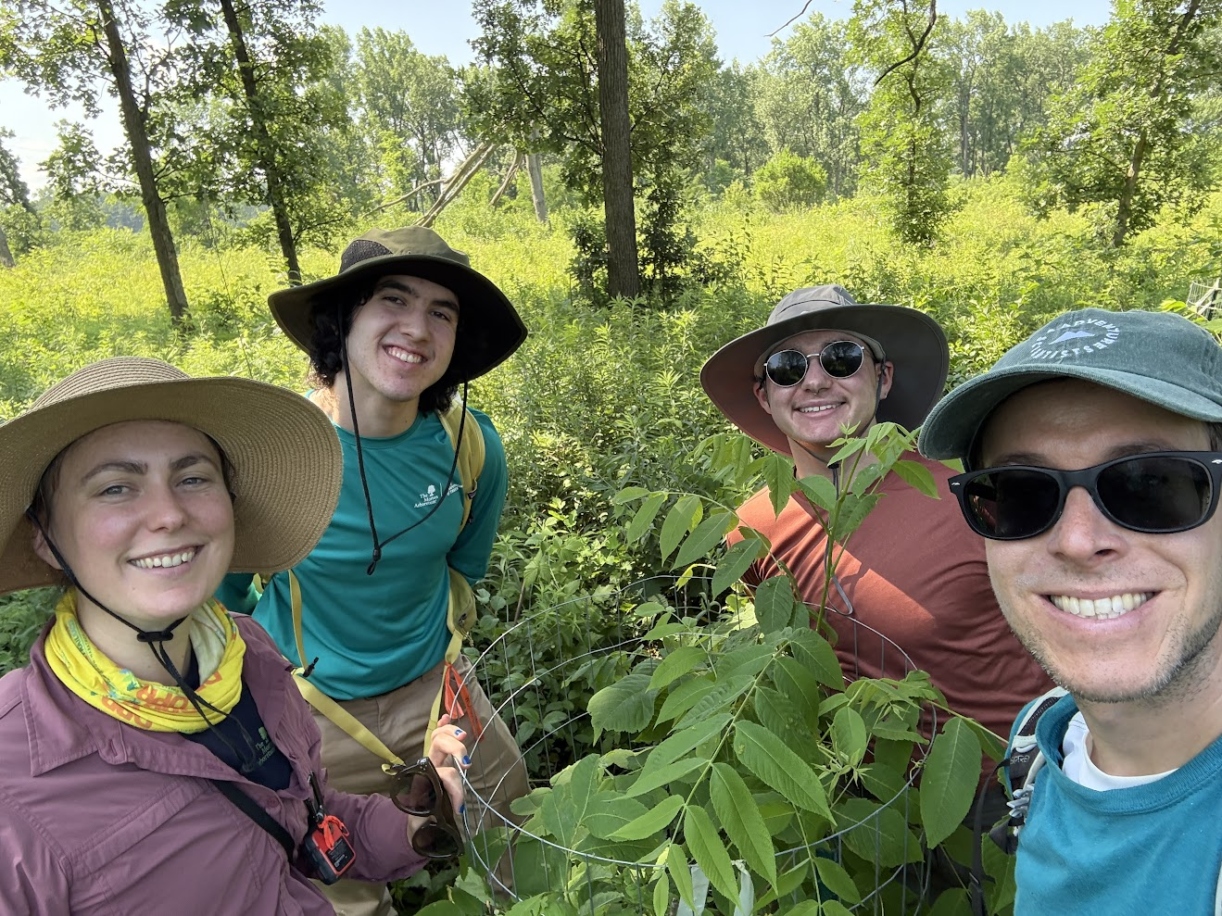
The Arboretum’s 1,700 acres are a wide-open laboratory for students in the Research Experiences for Undergraduates program to do their own research with mentors such as Sean Hoban (right), tree conservation biologist.
“I wasn’t expecting the amount of professional development,” said Deb Duong, who was an REU intern in 2024. She currently works as a research scientist at Drexel University’s Academy of Natural Sciences in Philadelphia while she prepares for graduate school. “It was really powerful to listen to active scientists talking about the paths they took to get to where they are now. It took some of them years. They took breaks. Some of them said, ‘If I had it to do it again I would do these things differently.’ The REU experience let me know I had time to figure it all out.”
Her current work is mostly on freshwater organisms, but the skills she learned working with Luke McCormack, PhD, research scientist in tree root biology, and Marvin Lo, root biology research program manager, are still with her. “At the Arboretum I was collecting tree leaves. In Pennsylvania I’m collecting samples from little rivers. But the process of collecting samples and analyzing them is essentially the same.”
REU students also learn from each other and often develop lasting connections, even if they don’t end up in tree science. “Going to tech school, everyone I knew was an engineering student,” said Kaplan, the robotics engineer. “I had so much fun at the Arboretum, getting to know people who were in such different fields in science.” She believes her Arboretum experience helped her learn to communicate across disciplines, an advantage in her career path.
At the Arboretum I was collecting tree leaves. In Pennsylvania I’m collecting samples from little rivers. But the process of collecting samples and analyzing them is essentially the same.
Bigger Arboretum lessons also follow the former REUs. The research Krochmal does at the water reclamation agency is about wastewater and water quality. “That’s very different from trees,” she said. “But after the REU experience, my eyes are more open. I can see how interconnected everything is, especially in urban ecosystems. I look at the trees along the waterways, by the streets and in the parks, and I know that they are an important part of the environment I study.”