A New Leader for 1,700 Acres of Plants

Mark Richardson is an explorer at The Morton Arboretum. As the new vice president of collections and horticulture, he is learning about the Midwest, the Chicago region, and the tree collections, gardens, and natural areas that are now his responsibility.
The Arboretum represents a major change from the 200-acre New England Botanic Garden at Tower Hill in Massachusetts, where he was most recently director of strategic horticulture, and from the East Coast, where he has spent his public garden career. “It’s such a big place,” he said. “The Morton Arboretum has 1,700 acres that are managed really well.” That’s a lot to take in, but it makes space for big ideas.
Richardson (above) is now in charge of all the Arboretum’s plants and the landscapes and ecosystems they live in—prairies, creeks, meadows, marshes, woodlands, and gardens. It’s his job to lead the horticulturists who meticulously manicure The Grand Garden; the arborists who prune and monitor magnolias, oaks, and maples collected from around the world; and the volunteers who battle buckthorn in the restored woodlands and prairies. Every plant, from the tulips that bloom in spring in the Arbor Court flower beds to the saplings in the Plant Breeding Nursery, is under his purview.
More than 20 years of experience in public horticulture prepared him well to succeed Kris Bachtell, who recently retired after 43 years at the Arboretum. Richardson previously directed horticulture operations at the Garden in the Woods of the Native Plant Trust (formerly the New England Wildflower Society) in Massachusetts.
With degrees in public horticulture, he is also an educator, with experience running education programs in Maryland and at Longwood Gardens in Pennsylvania. He is the author of Native Plants for New England Gardens and a passionate advocate for native plants and ecological gardening.
The Morton Arboretum was well-known to Richardson before he came here. He had visited, and for many years had known the reputation of its tree collections, science, and global conservation work. “This organization does so much and has such a wealth of resources,” he said. “There’s so much expertise in its horticultural staff and its science staff.”
As executive director of the U.S. branch of Botanic Gardens Conservation International, he collaborated with Murphy Westwood, PhD, the Arboretum’s vice president of science and conservation, and President and CEO Jill Koski, whom he calls “an exciting visionary.” “We’re delighted that Mark is joining our senior management team to advance our vision of a greener, healthier, and more beautiful world where people and trees thrive together,” Koski said.
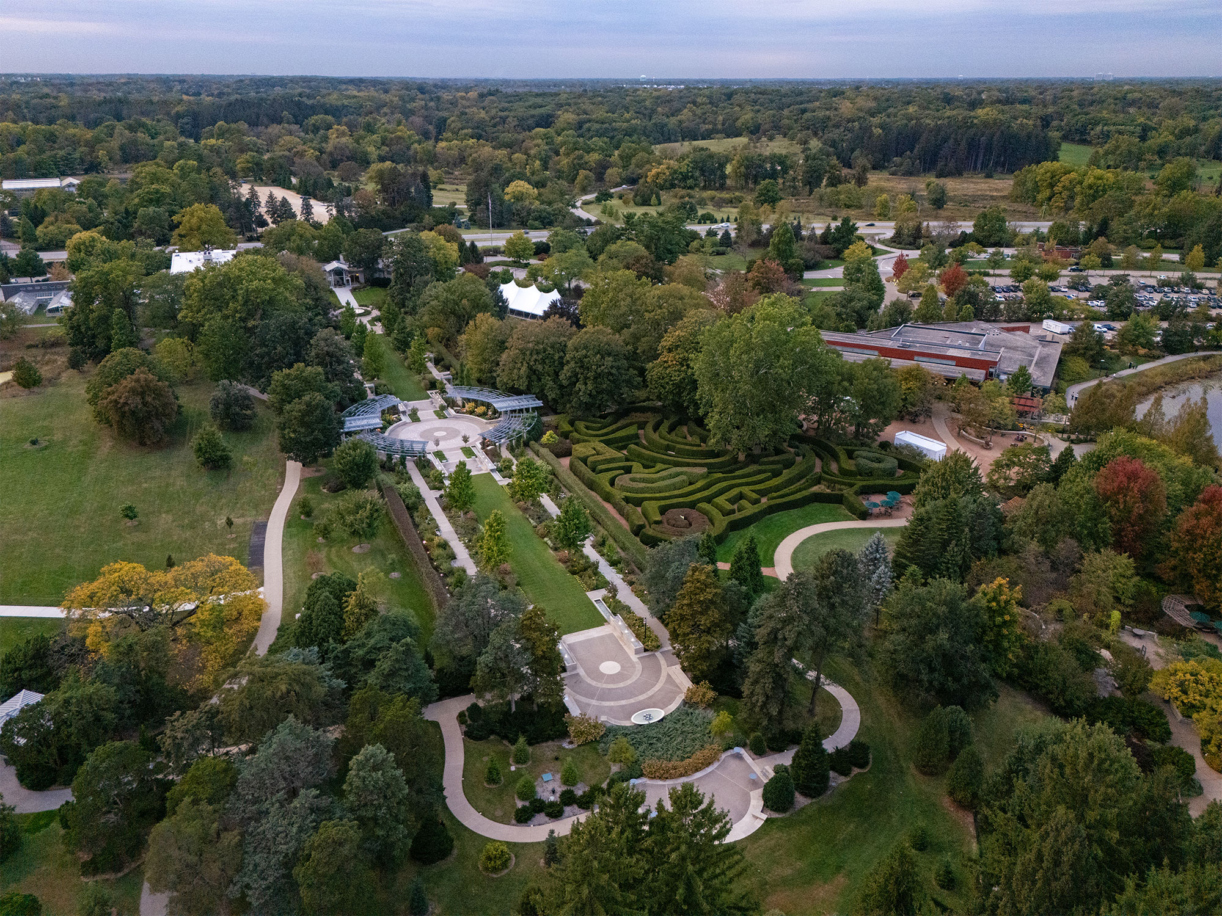
As vice president of collections and horticulture, Richardson is now responsible for every plant in The Morton Arboretum’s 1,700 acres.
In his first few months, Richardson has been getting to know the place and its people and plants. He already has strong guiding principles.
One is that the work of a botanical garden must be grounded in nature, evolution, and plants. He’s determined to build deeper connections between the living landscape of the Arboretum and its other mission-based work “to blend science and conservation with horticulture and collections management and to support the restoration of the wild.”
He will be adding to a deep legacy at an institution that was founded more than a century ago to support horticulture and tree research. Scientific instruments are frequent sights in its tree collections and forestry plots, and its conservation groves nurture endangered tree species.
To members and guests, the Arboretum is a place to enjoy nature, and making connections between people and plants is one of the institution’s core goals. Richardson has ideas for ways to use plants to encourage guests to explore the grounds more widely. For example, he has noted that, for its size, the Arboretum’s gardens are few, small, and mostly clustered near the Visitor Center. “Where can we create some more horticultural interest to invite people out to make a longer journey?” he mused.
Yet beauty must always serve the main goal of collecting and preserving plants for research and conservation, he said. “Our primary function is the preservation of plant species.” The support of the Arboretum’s generous donors is crucial to fulfilling that mission.
Another of Richardson’s guiding principles is an affinity for native species of plants. When he’s asked for suggestions about home gardens, “I’ll always default to natives,” he said. “They have a ton of benefits, and it’s a great way to reflect what’s unique about the place you’re in.” He and his family have been delighted by their encounters with the restored prairies of the Chicago region.
His love of native plants is no bar to taking charge of a place whose plant collections come from around the world. “Generally, I’m a plant lover,” he said.
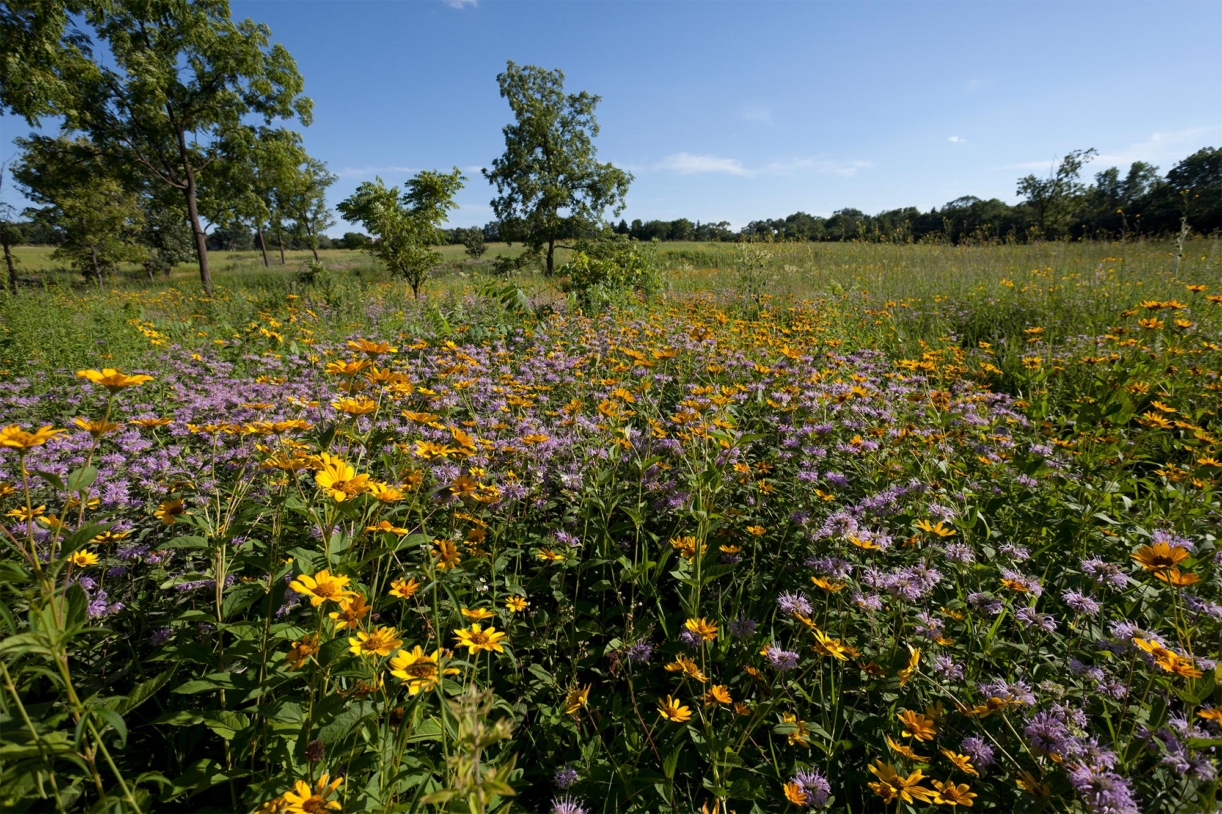
Richardson, the author of a book on New England native plants, is finding many familiar species in the Midwest, including the prairie plants in the Schulenberg Prairie.
How those plants are cared for is also part of his foundation. Richardson is a staunch supporter of ecological landscaping, which he defines as “a sustainable approach to conventional horticulture that emphasizes environmental quality.” As executive director of the Ecological Landscape Alliance, he worked to spread the word about better practices, such as minimizing fertilizer and pesticides in lawn care.
“At the Arboretum, we have a ton of land and a lot of opportunities to showcase best practices,” he said. For example, he’s already decided that diesel- and gas-powered equipment such as leaf blowers, lawnmowers, and golf carts should be phased out in favor of electric versions that result in lower emissions.
That kind of thinking has a direct bearing on perhaps the biggest challenge facing The Morton Arboretum, its trees, and its community: the changing climate. Already, the weather has become more volatile. Scientists predict that in coming years and decades, there will be more stretches of drought and more rainfall, with increased threat of intense storms that can bring flooding. Leading the adaptation of the Arboretum’s landscape and collections to handle these changes will be one of Richardson’s main jobs.
He and his family—wife Allison, two nearly grown sons, and an 8-year-old daughter—had not expected to leave New England, where he grew up and has spent the majority of his career. “I was settled,” he said. When the possibility of moving to Illinois came up, he said, “I needed to be really convinced.” But ultimately, the challenge of being part of The Morton Arboretum’s future and the scale of its possibilities were irresistible.
Recently, he and his high-school-senior son took a road trip to look at colleges and were struck by the contrast between cozy New England and the flat expanse of northern Illinois. “Here, the landscape is vast,” he said. “It feels like you can see forever.”
The Arboretum is also a place to see far and wide, and Richardson is scanning its horizon. “I want to see The Morton Arboretum serve as a model for how modern-day botanical gardens can best support biodiversity,” he said. “There is so much space here, and so much opportunity for people and for plants.”