Planting a tree correctly is essential to the long-term health of the tree. Mistakes made during planting usually can’t be corrected after planting and can lead to the decline of the tree.
Trees can be obtained from a nursery in many forms—bare root, container-grown, balled and burlapped, or dug by tree spade. Transplanting can be successful with all forms.
Always put extra effort into the planting process to ensure a good start for your tree. The faster the root system is re-established, the more likely you will have a tree that thrives and grows well.
Understanding the Planting Site
The planting site should meet the needs of the tree in terms of soil conditions and sun exposure. A proper site supports good root growth and allows the tree to grow well. Before planting begins, the site should be cleared of weeds to reduce competition. Ideally, sod should also be removed from the immediate area, as it can be very competitive as well. Removal of sod allows for proper digging of the planting hole, as well as installation of mulch after planting.
Planting Procedure
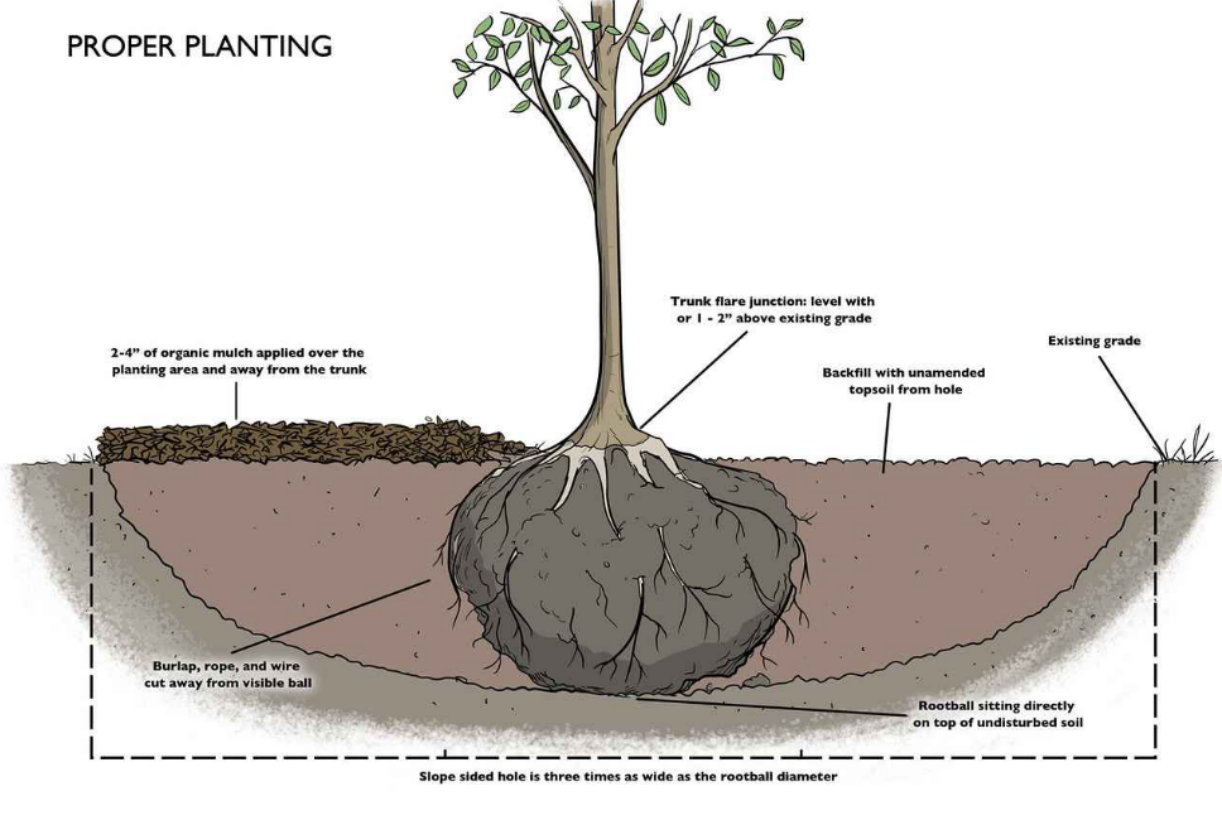
The planting hole should be wider than the roots or root ball. Two to three times wider is recommended.
Planting too deep is one of the most commonly encountered problems of landscape trees. Dig the hole only as deep as the depth of the roots or root ball. The bottom of the planting hole should be left undisturbed, because the tree needs support from underneath to stabilize it. If the bottom of the planting hole is disturbed, the weight of a large root ball could compress the soil, causing the whole tree to sink down and be planted too deep. Make sure the area of the trunk that flares out near the soil line is visible and is at least 1/2 inch above the soil. The uppermost lateral roots should be just below the soil surface.
The sides of the hole should slope up gradually, making it saucer- or bowl-shaped.
Bare-Roots Plants
Trees are sometimes sold bare-root, meaning they have no soil ball. Dig the planting hole as deep as the root system. Build a small mound of soil on which the center of the root system can sit. Lay a shovel across the hole and use it to get the flare of the tree at soil level. Spread the roots out in a natural pattern. Adjust the soil mound under the center of the root system, if needed. Have another person hold the tree steady. Carefully backfill the planting hole with the soil that was removed from the hole, gently filling around the roots to eliminate air pockets. No soil amendments are needed.
With the extra remaining soil, a saucer or water basin can be created around the outer edge of the soil ball, if desired. This will keep water in the root zone and prevent runoff. The basin should be removed before winter.
Container-Grown Plants
Remove the plant from the container or packaging material and inspect the root system for dead or injured roots. Remove damaged roots and cut back spiraling roots to encourage proper development. Shaving a thin layer of roots from the root ball (known as boxing) is a good way to eliminate roots circling along the container wall.
Center the plant in the planting hole. Keep it straight while backfilling the soil. Backfill the planting hole with the soil that was removed from the planting hole, gently filling around the rootball to eliminate air pockets. No soil amendments are needed.
With the extra remaining soil, a saucer or water basin can be created around the outer edge of the soil ball, if desired. This will keep water in the root zone and prevent runoff. The basin should be removed before winter.
Balled and Burlapped Plants
Check the rootball before planting. In some cases, the trees may come from the nursery with the roots already too deep in the root ball. This is often due to mechanical operations that took place in the nursery field. Before planting, open the burlap and remove any soil that is hiding the root flare of the tree. The root flare should be visible before planting.
Once the plant is in the hole, remove all twine and cut away as much burlap as possible. If the plant is in a wire basket, remove as much wire as possible. Low-profile baskets are designed so no wire needs to be removed.
Backfill the planting hole with the soil that was removed from the hole, gently filling around the roots to eliminate air pockets. No soil amendments are needed. As with container grown plants, an optional soil saucer can be put in place after planting.
When to Plant Trees
Spring
For many species, spring is the best season for planting. The longer growing season allows roots to re-establish before winter. Some slow-to-establish species are best planted in spring. These include:
- Bald-cypress
- American hornbeam
- Ginkgo
- Larch
- Magnolia
- Hemlock
- Sweetgum
- Tuliptree
- Willow
Fall
Fall is also considered a good time to plant, but be sure to allow six weeks before the ground freezes for plants to establish new roots. Warm soils are needed to promote new root growth.
Fall planting can offer advantages over spring planting. Loss of water through the leaves is lower and root generation potential is high. Air temperatures are typically moderate to cool and are easier on plants, so there is less chance for trees to be stressed by heat. Fall rains help trees and shrubs establish their root systems. When air temperatures are cooler than the soil, new root growth is encouraged, without new top growth. The result is a stronger, better-developed root system for the next spring when the plants begin to grow.
Waiting too long into the fall season (November to December) to plant increases the risk of poor root growth and slower establishment. Some species do not establish as well in the fall as they do in spring, when planted balled and burlapped.
Summer
Many species can be planted in summer, especially those that are container-grown. The challenges of summer are heat and low rainfall. Summer planting is possible, but requires a regular watering program to be followed.
Watering
Proper watering is the single most important aspect of maintaining newly planted and transplanted trees. Too much or too little water can cause damage.
In the first few months after planting a tree, most of its moisture comes from the root ball. The only way to evaluate soil moisture is to gently probe the soil in the root ball and check its moisture.
Even after trees are well established, they should be watered thoroughly during periods of low rainfall.
Tree irrigation bags have permeable bottoms, which allow the water to drip into the soil of the rootball, where it is needed most. They have the advantage of delivering a specific amount of water. They need to be filled regularly (every 5 to 7 days on average) to be effective. Remove at the end of the season, when not needed.
Mulching
Properly applied mulch can increase tree growth in the first few years after planting.
An even layer of mulch, 3 to 4 inches deep, with a diameter at least four times the diameter of the root ball, should be placed around every newly planted tree. This will help to conserve soil moisture and moderate soil temperatures.
Do not mound the mulch or let it rest against the trunk of the tree.
Fertilizing
Fertilizing at the time of planting is not recommended.
Research has shown that fertilizer is ineffective until the tree has had time to partially re-establish its root system. Proper watering will aid in the development of new roots.
For spring planted trees, fertilizer can be applied in fall. Fall-planted trees can be fertilized the next spring or fall.
Staking
Not every new tree needs to be staked. It may be warranted in high pedestrian traffic areas or in situations where stability may be an issue.
When stability is a problem, as in windy sites or sandy soils, trunks of trees may be staked for 1 to 3 years, until new lateral roots develop to stabilize the tree. Stakes must reach down into undisturbed soil outside of the rootball to be effective. Avoid staking too rigidly. Trees need to sway gently in the wind to develop strong wood at the base of the trunk. The ropes or wires used for staking should be cushioned with something soft and pliable where they come in contact with the tree, so as to avoid damaging the bark.
Unusually large trees may need to have guy wires installed for stability. This is best done by a trained professional.
Guy wires or staking materials should be checked monthly during the growing season to prevent damage to the bark. Stakes should be removed in spring and guy wires should be adjusted in spring. Trees will increase in girth in spring, and failure to loosen or remove stakes and guy wires can girdle a tree.
Trunk Wraps
Trunk wraps are optional. Trees can be protected by wrapping trunks in late fall, from the bottom up so that the wrap overlaps like shingles. This allows water to flow off of the wrap, rather than soaking under it.
There are numerous tree wraps and loose tree collar wraps available commercially. Trunks are often wrapped to prevent animal damage. Choose a wrap that is meant for that purpose. Not all wraps are sturdy enough to protect against animals.
Remove the wrap in spring, since the tree will increase in girth at that time. Tree wraps can also become a home for insects. Removal in spring allows for inspection of the trunk for that type of problem.
Pruning
It is very important to ensure the best possible branch structure while trees are young.
At the time of planting, remove all rubbing, dead, or broken branches.
Pruning should continue in the early years of a tree’s life in order to build a strong structure.
Evergreens have needs different from those of deciduous trees.
Transplant Stress
Research has shown that a tree dug from the nursery field and then balled and burlapped can lose 80 to 95% of its root system. This causes a great deal of stress. After transplanting, the tree may form fewer and smaller leaves, and grow very little. How long the stress period lasts depends on the size of the tree, the planting site, and the care given to the tree.
A small tree (2 to 3 inch diameter), planted on a good site and given adequate water, should return to vigorous growth in 2 to 3 years. A poor site or inadequate care will lengthen this period. Large trees take longer to recover from transplanting than small trees; approximately one year of recovery is needed for each inch of trunk diameter. As long as branches are not dying and growth improves each year, the tree is doing well.