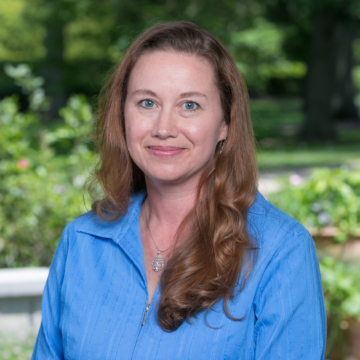
Rebekah Mohn, PhD, studies population genomics of Quercus macrocarpa (bur oak) and co-occurring white oak species in order to understand hybridization, gene flow, adaptive introgression, and phylogeography of this and related species.
Mohn is interested in studying plant diversity, specifically the role of gene flow/gene shuffling between species whether through hybridization or allopolyploidy (the doubling of genetic material after hybridization) in enabling plants to adapt and evolve. She became interested in plant diversity when identifying plants in her backyard in middle school. This further developed while collecting herbarium vouchers for the Flora of Missouri project. In college at Miami University, she became interested in polyploidy and plant variation when she noticed size variation in Erythronium albidum (white trout lily) and saw documentation that size variation between white trout lily species is correlated to ploidy levels.
These interests in chromosome evolution and speciation took her to University of Minnesota where she completed her PhD under Dr. Ya Yang, studying the rate of single chromosome evolution and polyploidy (genome doubling) in Drosera (sundews), as well as the phylogenomics of these species using transcriptomes. In Drosera most of the polyploid species are allopolyploid, meaning that one genome comes from one species and the other genome comes from a different species. This often enables these plants to occur in a wide variety of habitats.
Similarly, when plants hybridize, genes from one species can move to another species over generations, allowing a species to capture adaptations from closely related species. Interest in hybridization and the role of introgression in adaptation brought Mohn to The Morton Arboretum, where she is studying how introgression allows oaks (Quercus) to adapt to their environment. She utilizes genetic sequencing, herbarium specimens, and trees on the grounds to answer her research questions.