The Real Wildlife Behind Vivid Creatures
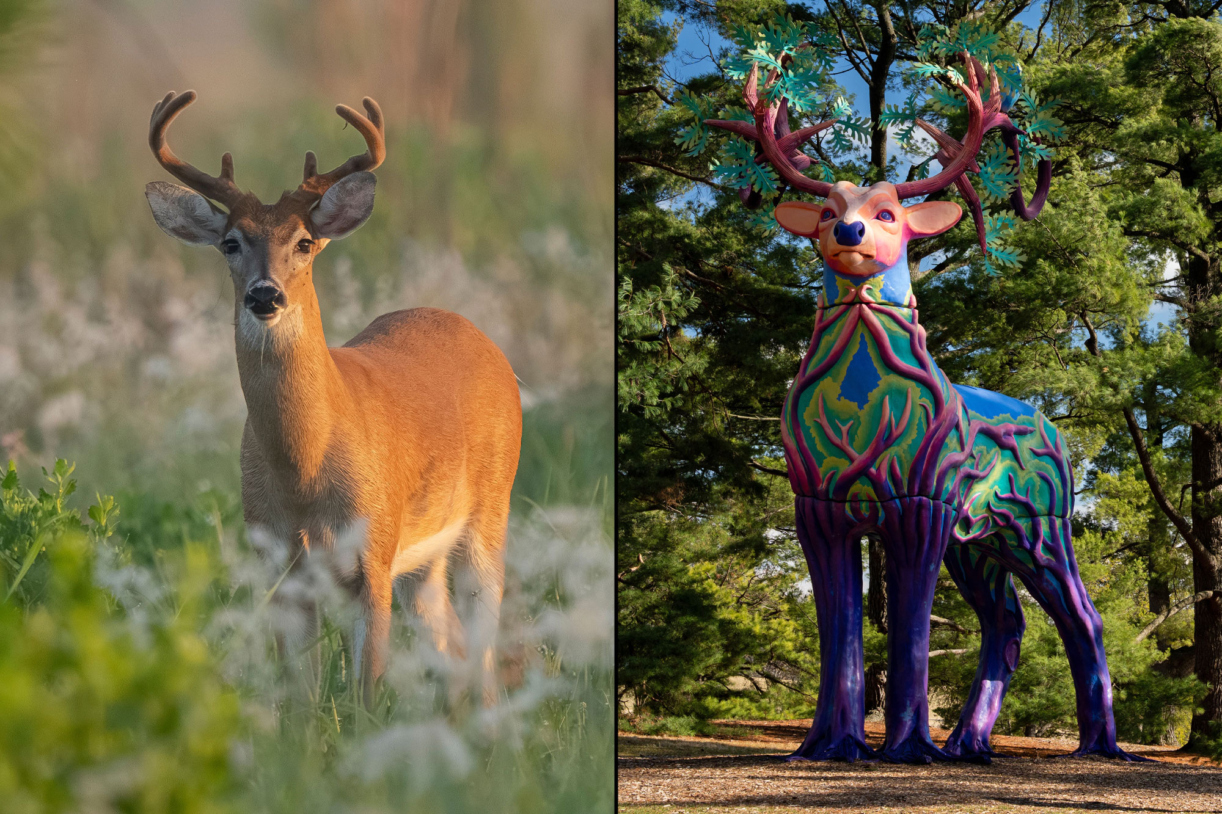
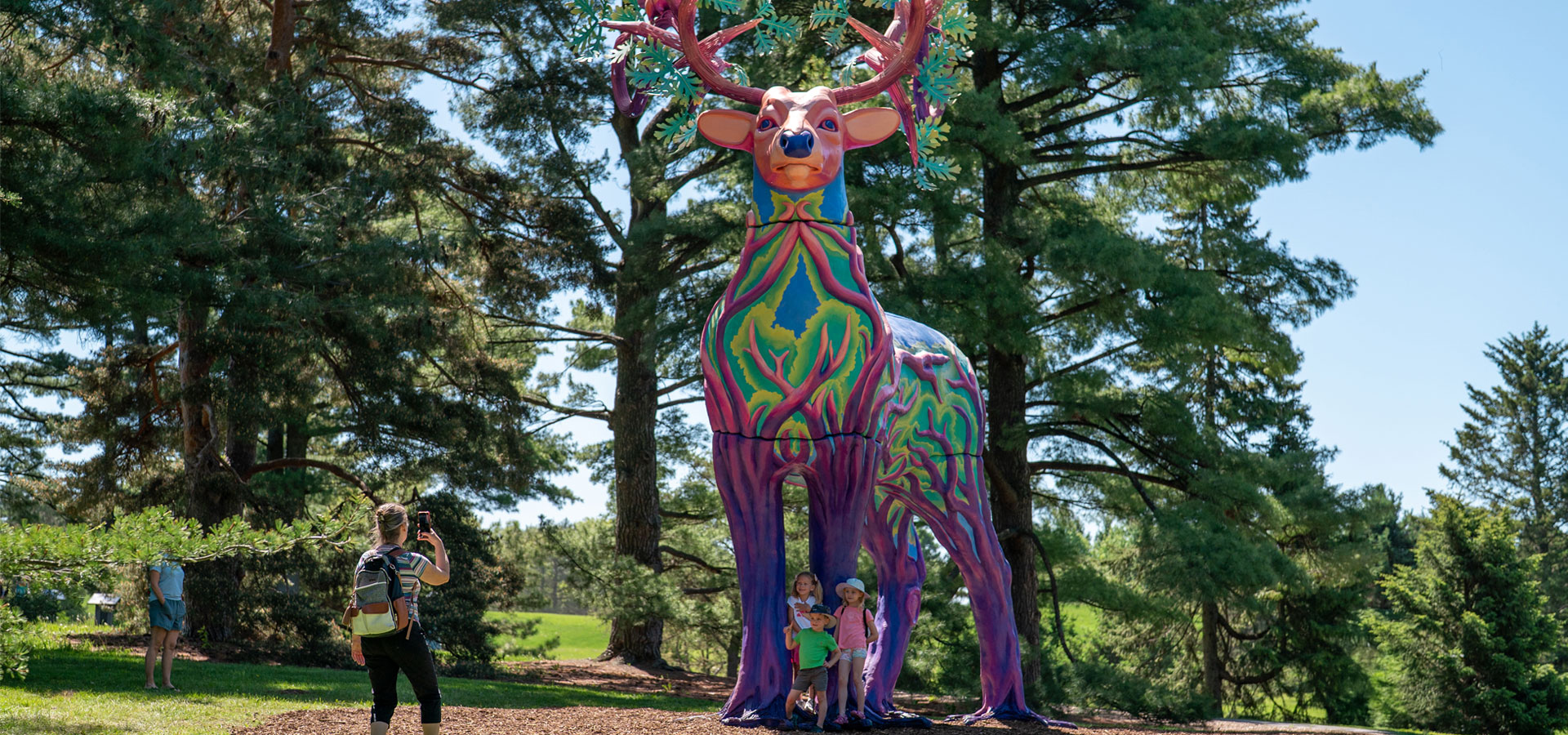
When you meet a 22-foot-tall blue stag swirling with color and whimsical imagery at The Morton Arboretum, he is only partly a fantasy. He was inspired by the real white-tailed deer that live in the Arboretum’s woods, browsing on plants and on acorns from its many oaks. If you stroll the Arboretum’s trails in the early morning or near dusk, you may see them among the trees.
Like all five of the huge sculptures in the Vivid Creatures art exhibition at the Arboretum, Generosity the deer represents the wildlife of the Arboretum and the Midwest. The sculptures were created by artists and life partners Heather BeGaetz and Fez BeGaetz of Portland, Oregon, who visited the Arboretum to learn about its trees and wildlife. The five kinds of animals that inspired the artists to create these bright and lively artworks share the landscape with us, in a Chicago region that is more wild than you might think. Here’s a look at the real animals behind the giant-size versions.
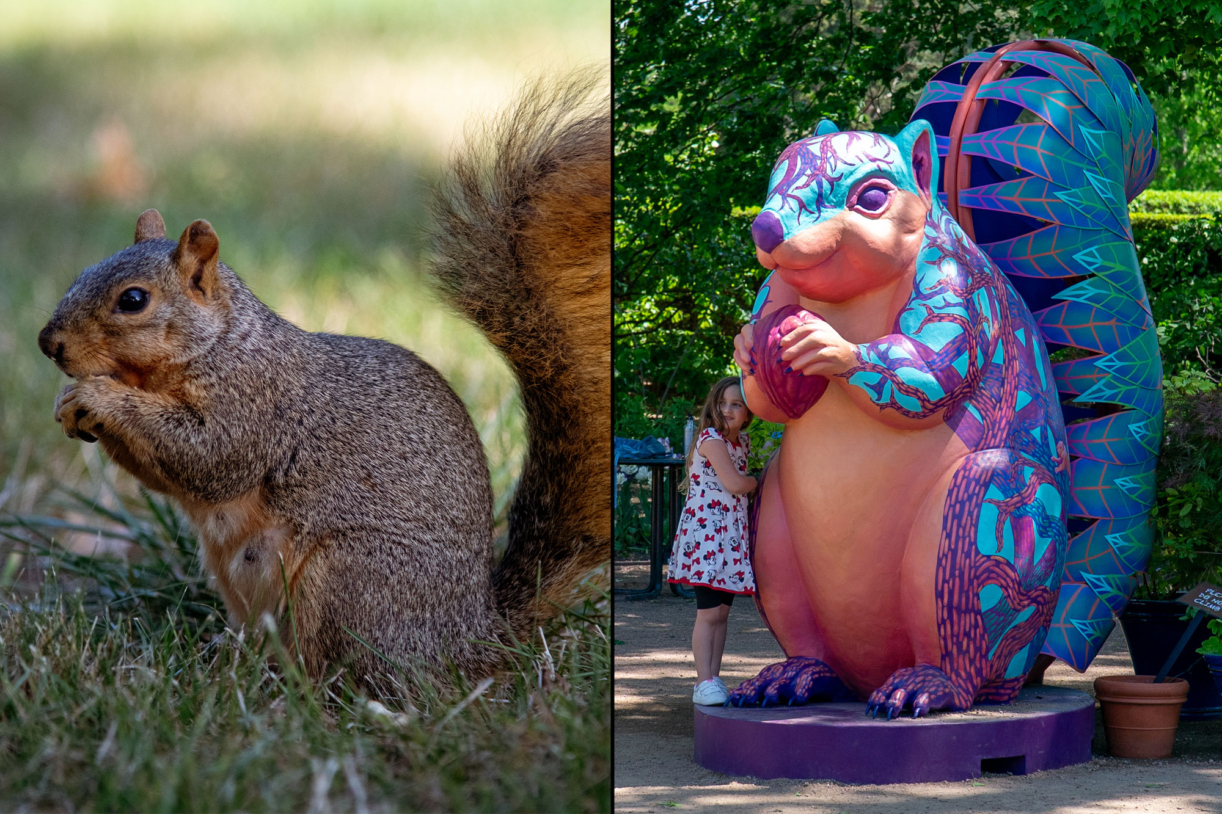
Scamp the Fox Squirrel
Scamp is the first animal sculpture you’ll see, in Arbor Court outside the Visitor Center.
Fox squirrels and gray squirrels are the ones you’re most likely to see in the central areas of the Arboretum or in backyards throughout Illinois. They aren’t as brightly colored as Scamp. Fox squirrels have a gray body with a reddish-orange tail and belly. Eastern gray squirrels are a little smaller and are shades of gray, with just a touch of light brown around the face. If you see a black squirrel, it’s a gray or fox squirrel with a black color mutation.
Fox and gray squirrels are quick, nimble, feisty, and curious. They explore everywhere, especially in autumn, when they need to find and stash a lot of food for the winter. Squirrels don’t hibernate, although they may slow down and snooze when the weather is especially harsh. They shelter from bad weather and raise their young in holes or hollows of tree trunks or in nests called dreys that they build from dry leaves in the treetops.
Fox and gray squirrels are very well adapted to living in urban areas, where they can nest in nooks and crannies of buildings and have a plentiful supply of discarded human food.
A squirrel’s toolbox is its fluffy tail. When it leaps, the tail helps it balance. When a squirrel sleeps, it curls up in its tail to keep warm. When it feels threatened, it may fluff up its tail to look larger and more formidable. In hot weather, the tail can shade a squirrel and help it discharge heat. Tail twitches are squirrel-to-squirrel communication.
Squirrels and trees go together. Trees shelter and feed squirrels and squirrels plant trees by burying nuts such as acorns, hickory nuts, black walnuts, and beech nuts. Although they have a phenomenal memory for where they bury these tree seeds, squirrels inevitably lose track of a few. Some will germinate, and a few of those will grow up to be the next generation of stately oaks and other trees.
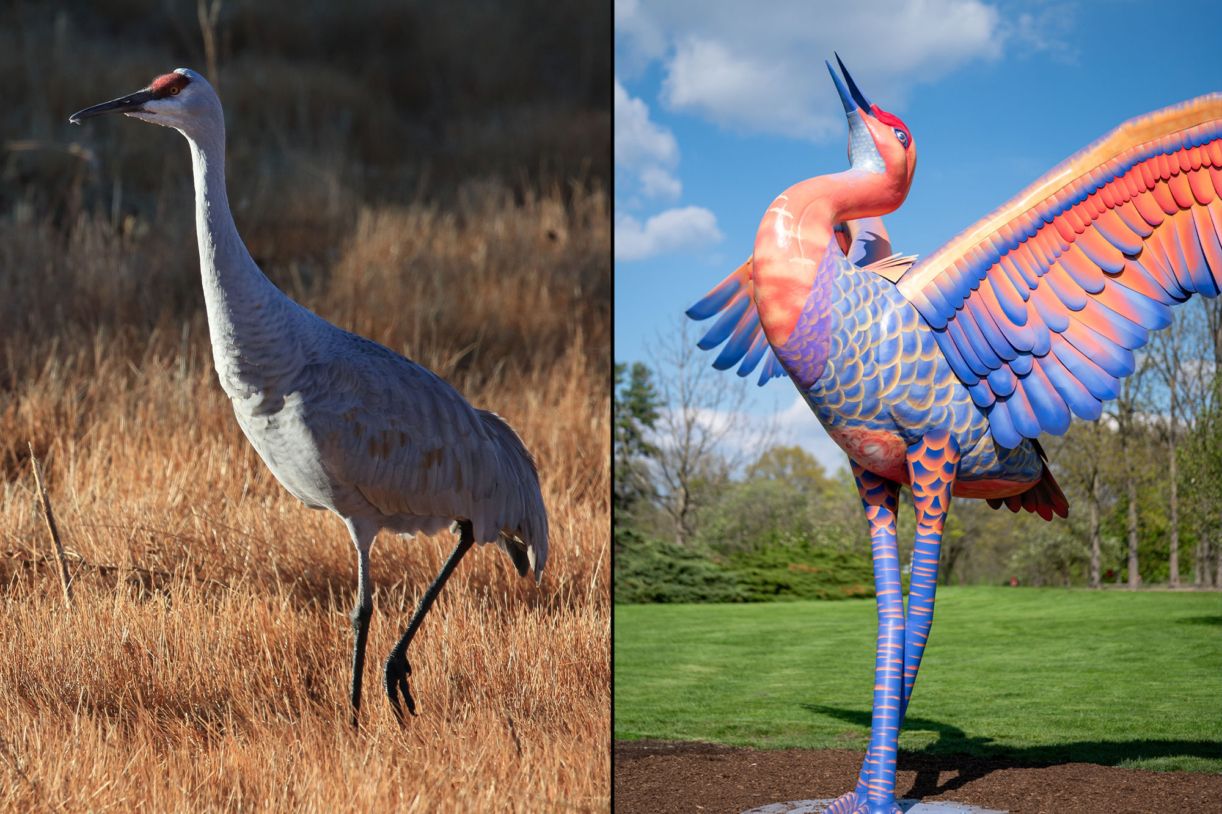
Cadence the Sandhill Crane
You’re most likely to see sandhill cranes high above your head as they migrate over Chicago, except for the 26-foot-wide one you can see up close at The Morton Arboretum. Real sandhill cranes are not as large as colorful Cadence, although they are big birds with long legs and a 4-foot wingspan.
Sandhill cranes live in bogs, marshes, and wet prairies throughout the center of North America, including northern Illinois. They overwinter in southern regions such as Texas and New Mexico. In spring and fall, the cranes migrate in groups of hundreds of birds, communicating with a trumpetlike call. “They can be loud,” said Spencer Campbell, senior manager of natural areas at the Arboretum. They navigate using a combination of clues such as the position of the stars and the earth’s magnetic field.
The cranes are omnivores, eating not only plants, including seeds and berries, but animals such as insects, worms, snails, snakes, frogs, and mice. During their fall migration, they can often be seen flocking to eat leftover grain in recently harvested fields.
Cranes are famous for their graceful, bounding mating dances. Sandhill cranes mate for life, which can be as long as 20 years, and raise their eggs in huge nests they build on the ground. Although they do breed at a few sites in northern Illinois, none are known to be nesting at the Arboretum.
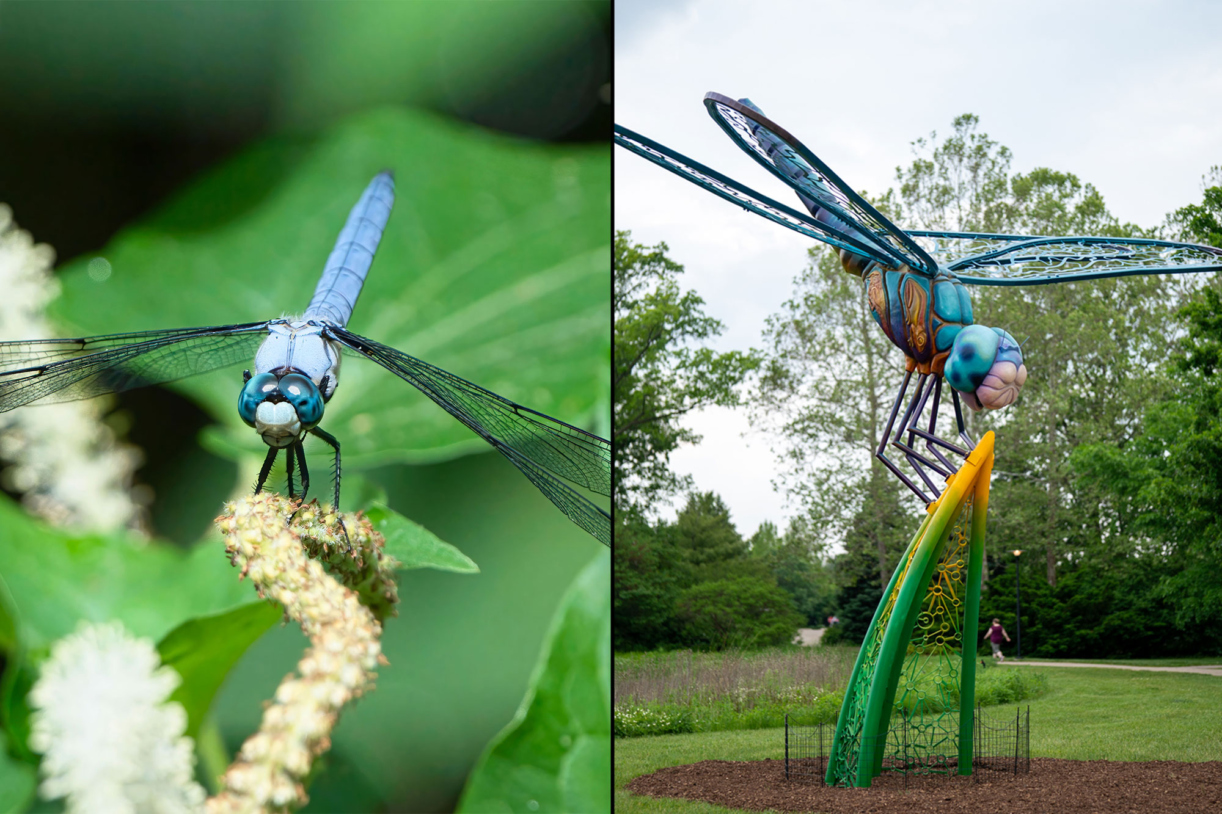
Nimbly the Dragonfly
There are at least 54 species of dragonflies and damselflies at The Morton Arboretum, although none of them has a 30-foot wingspan like Nimbly. Most are in the 4- to 6-inch range.
Dragonfly species come in many colors—blue, green, red, purple, turquoise—often with a metallic sheen. The long, big-eyed body between their widespread pairs of wings has earned some species the common name of “darning needle.”
The closely related dragonflies and damselflies are similarly built, but they differ in how they hold their wings and their manner of flying. Damselflies flutter more like butterflies, while dragonflies are swift, agile fliers.
Dragonflies are predators—fast, accurate ambush hunters that zoom in like fighter planes to snatch mosquitoes and other insects from the air. “People don’t realize how much dragonflies do to keep the mosquito population down,” Campbell said. “They’re fascinating to watch because they’re such acrobats.”
The Arboretum has many dragonfly and damselfly species because its tree collections, gardens, and natural areas offer a wide range of habitats, from woods to prairies to wetlands. Of the Arboretum’s known 54 species, nine are considered threatened, reinforcing the importance of habitat conservation.
Most dragonflies live near water, where they lay their eggs and often hunt. Sometimes in spring, after the larvae of other insects have hatched to provide fresh prey, the Arboretum’s ponds and lakes seem to be a cloud of dragonflies.
Generosity the Deer
That tall blue stag sculpture, Generosity, was inspired by the white-tailed deer, a species that lives almost everywhere east and south of the Rocky Mountains. White-tails are highly adaptable, feeding on hostas and other garden plants as happily as they nibble wildflowers and tree buds. They can be found throughout the Chicago region.
The deer are named for the fluffy white undersides of their tails, which they flash in alarm when they’re spooked. The largest animals in our forests, white-tailed deer feed on a wide range of plants, including berries, tree twigs, buds, and nuts such as the acorns that fall in abundance at the Arboretum. Where there are too many deer, they can strip a forest of undergrowth and young trees.
A male deer like Generosity replaces his antlers every year. Since a healthier, older deer grows larger antlers, they advertise his fitness to potential mates. He also uses his antlers to spar with other males to compete for females in the fall breeding season.
In late winter and early spring, white-tails grow new antlers, covered by a coating of fuzz called velvet that itches. The deer scratch by rubbing their antlers on trees. It doesn’t hurt a mature tree, but young trees with thin bark can be killed by deer rub. “That’s why you see so many young trees at the Arboretum surrounded by wire cages, to protect them from deer,” said Mark Richardson, vice president of collections and horticulture.
Spectra the Brittle Button Snail
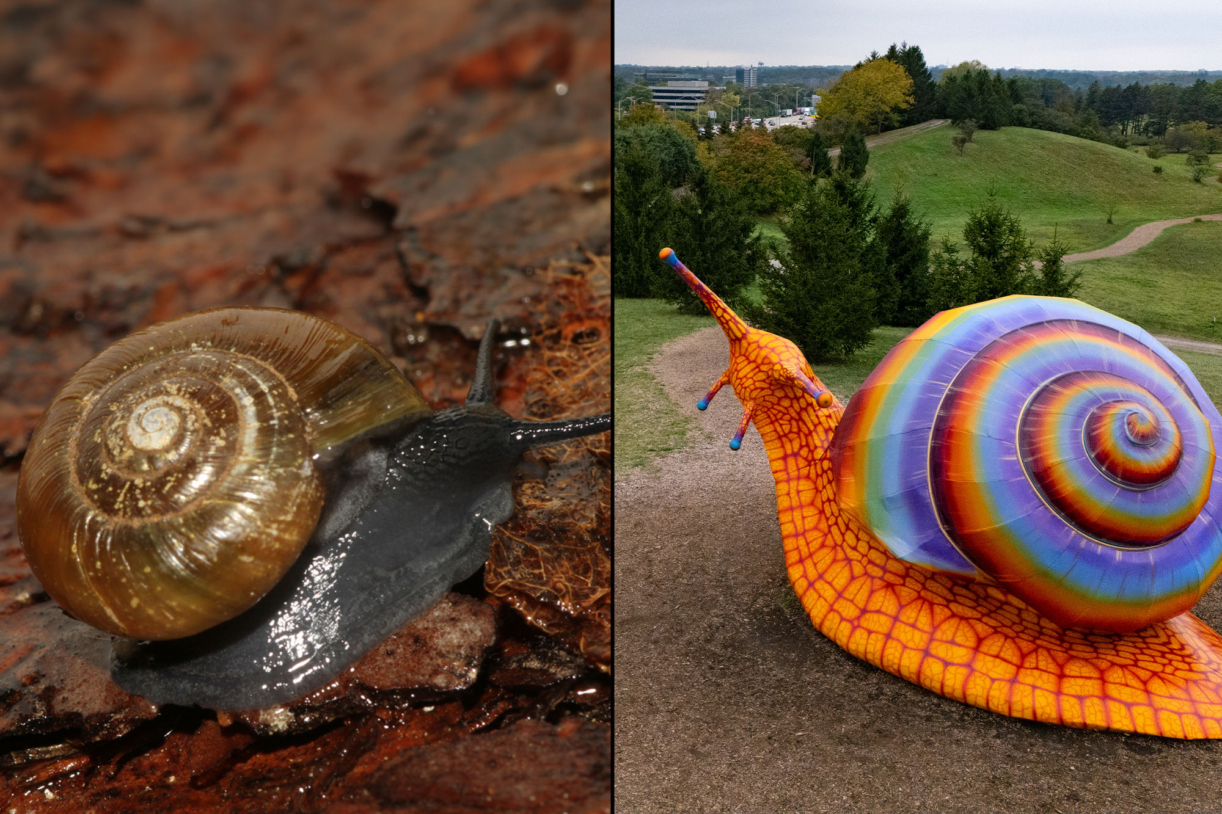
A cheery, multicolored snail 16 feet high greets motorists from the hill overlooking Interstate Highway 88 by the Arboretum. It was inspired by the shiny, tiny brittle button snail, less than an inch long, that lives sheltered beneath fallen leaves and logs that cover the ground in Illinois woodlands.
Snails grow spiral shells as armor to protect their soft, elastic, vulnerable bodies from the world. A snail is a slow mover that can be prey for a wide range of animals, so it’s useful to carry along a place to hide. The shell also keeps the snail from drying out and shields it from winter cold when it hibernates.
Most of a snail’s body stays inside the shell. The part that sticks out, called the mantle, has tentacles that the snail uses to probe its environment. It moves by slowly scooting its mantle along a slick of slippery mucus.
Brittle button snails consume the dead organic matter that falls to the forest floor, as part of the process that breaks down leaf litter into nutrient-rich humus that nourishes trees and other plants. Most land snails are hermaphrodites, with both male and female body parts in a single animal, and lay their eggs in the soil.
Although brittle button snails are common, they are so small, dark, and inconspicuous that you may never see one, unless you pause on a walk in the woods to lift up a few leaves and investigate what lives there.